How Many Holes You See in These Shorts Determines if You’re a Narcissist
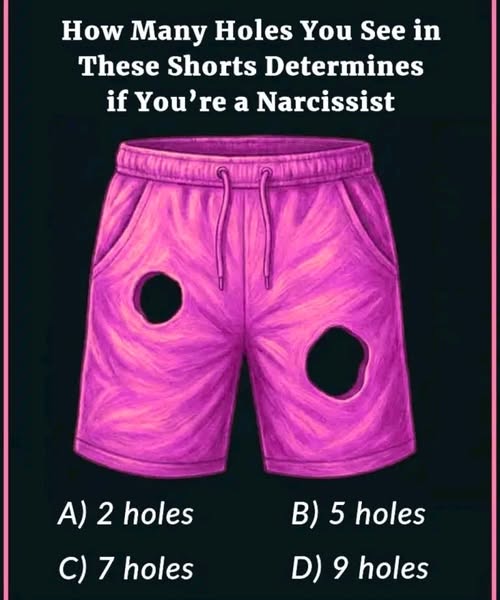
Have you ever paused on a simple image online and realized it might reveal something about how your brain works? That’s exactly what happened with a viral photo showing a worn pair of shorts with several visible holes. At first glance, it looks like an ordinary picture. But the caption often used with it—“How many holes you see determines if you’re a narcissist”—instantly grabs attention and invites people to test themselves.
Most viewers answer quickly. They notice the two obvious torn spots on the front of the shorts and confidently say the answer is “two.” That immediate reaction shows how the human brain often works: we tend to focus on the most noticeable shapes and patterns first. Our minds are wired to make quick judgments based on what stands out visually.
However, the debate begins when people start looking more closely. In addition to the two torn holes, the shorts also have the normal openings you’d expect in clothing: the waist opening and the two leg holes. When these are included, the total becomes five holes. Suddenly, what looked like a simple question becomes a small puzzle that depends on how you define the word “hole.”
Some people take the analysis even further. They notice that the torn holes go through both the front and back layers of fabric. From that perspective, each tear might count as two openings instead of one. Using that reasoning, the number can rise to seven or even nine depending on how someone counts each layer. This is where the conversation becomes interesting, because people start applying different types of logic to the same image.
So what about the “narcissist” label mentioned in the caption? In reality, it’s just a piece of attention-grabbing clickbait. The number of holes you count has nothing to do with narcissism or personality traits. Instead, the puzzle highlights how different people approach visual problems and reasoning tasks.
Those who answer quickly with “two” are often relying on instinctive thinking—focusing on the most obvious details without analyzing the entire image. People who arrive at higher numbers tend to slow down and examine the structure of the object more carefully. Neither approach is right or wrong; they simply reflect different ways of processing information.
This difference is something psychologists often discuss when studying perception and cognition. Our brains constantly balance quick pattern recognition with deeper analytical thinking. Sometimes we rely on fast instincts to save time, while other situations encourage us to analyze details more thoroughly.
The reason this image became so widely shared online isn’t because of the shorts themselves. Instead, it’s the conversation the picture creates. People compare answers, debate their reasoning, and try to convince others that their interpretation is the most logical. A simple visual puzzle suddenly becomes a social activity.
That kind of engagement is exactly why these types of images spread so quickly on social media. They’re easy to understand, quick to answer, and naturally spark discussion. Everyone feels curious to see whether their answer matches what others see.
The next time you come across a puzzle like this online, it might be worth taking a moment before giving your answer. Looking carefully at the details can reveal that there are often multiple ways to interpret the same image. More importantly, it can show how flexible and fascinating the human mind really is.
Sometimes, a simple pair of worn shorts can turn into a surprisingly fun way to explore perception, logic, and the different ways people think.






Post Comment