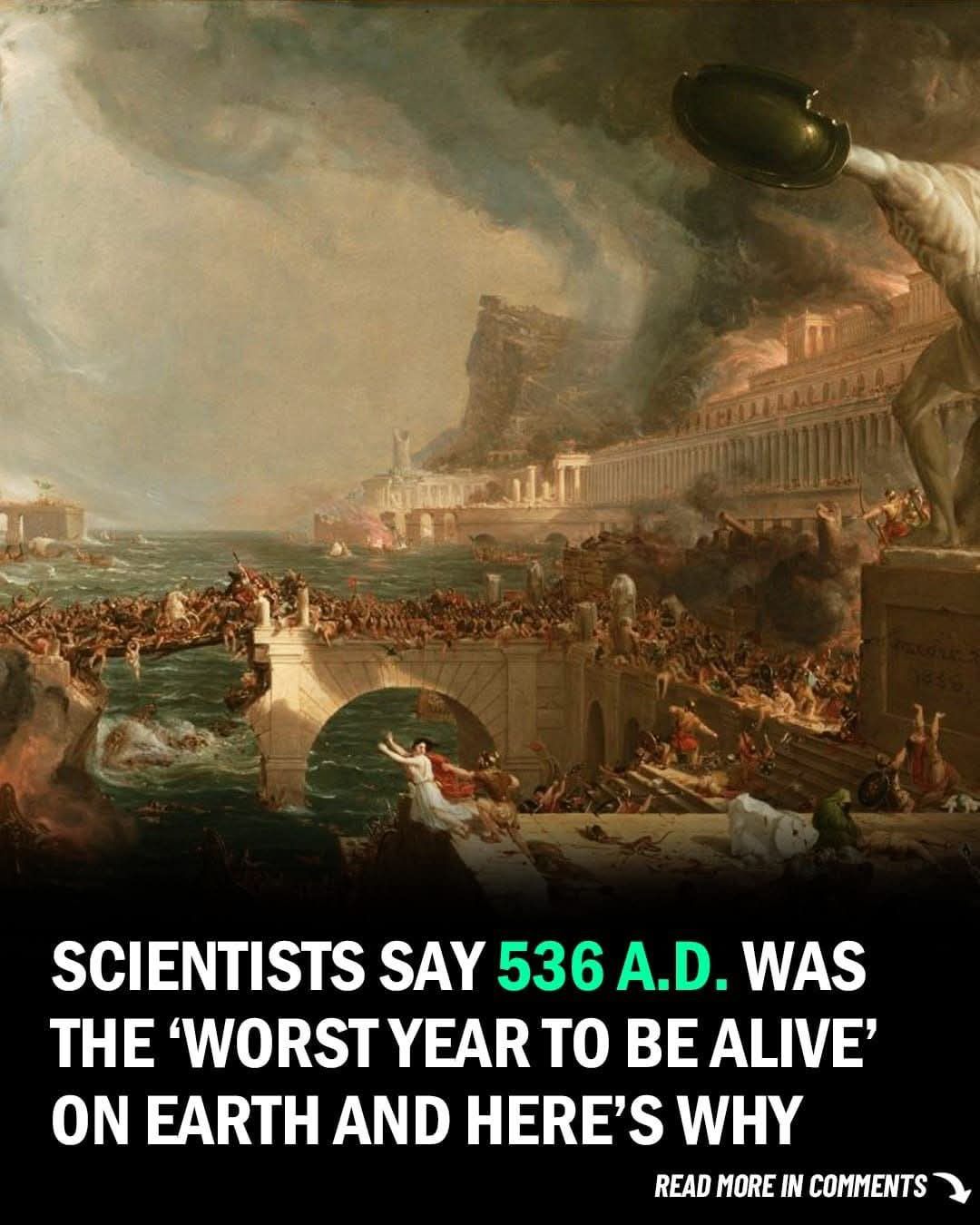
The worst year in history to be alive! 😧
When considering the darkest periods in human history, events like the Black Death or the 1918 flu pandemic often dominate the conversation. Yet historian Michael McCormick has identified 536 AD as potentially the worst year ever recorded. During this time, a mysterious and persistent fog enveloped Europe, the Middle East, and parts of Asia, triggering widespread devastation and altering the course of history.
For nearly eighteen months, a dense haze obscured the sun, casting entire regions into near darkness. Byzantine historian Procopius described the phenomenon vividly: “For the sun gave forth its light without brightness, like the moon, during the whole year.” This loss of sunlight caused temperatures across the Northern Hemisphere to plummet by an estimated 1.5°C to 2.5°C, making the 530s one of the coldest decades in recorded history. In China, summer snowfalls were reported, while crop failures struck globally, resulting in widespread famine. Irish chronicles from the period detail severe food shortages from 536 to 539, underscoring the global nature of the crisis.
The environmental disaster was compounded in 541 AD by the outbreak of the Plague of Justinian, a bubonic plague that swept through the Byzantine Empire, killing millions. Mortality rates in heavily affected regions ranged between 25% and 50%, dealing a further blow to already weakened populations and contributing to the long-term decline of the empire. The convergence of climate disaster and disease made this period extraordinarily lethal.
For centuries, historians and scientists puzzled over the cause of this mid-sixth-century catastrophe. Recent research led by McCormick, alongside glaciologist Paul Mayewski, has shed new light on the events. Analysis of ice cores from a Swiss glacier revealed that a massive volcanic eruption in Iceland in early 536 AD likely released a vast cloud of ash across the Northern Hemisphere. This initial eruption was followed by additional volcanic events in 540 and 547, prolonging the global climate crisis. These successive disasters, coupled with the plague, triggered economic and social turmoil in Europe that lasted over a century.
The ice cores also offer evidence of eventual recovery. By 640 AD, rising levels of airborne lead—a byproduct of silver mining—suggest that trade and industry were beginning to rebound after the prolonged period of hardship. This indicates that while the impact of 536 AD was devastating, human societies eventually adapted and recovered, highlighting the resilience of civilizations in the face of extreme adversity.
The investigation into this period began in the 1990s when tree-ring studies revealed unusually cold years around 540 AD. Subsequent analyses of polar ice cores from Greenland and Antarctica confirmed that significant cold periods over the past 2,500 years often coincided with major volcanic eruptions. These findings pinpointed a substantial eruption in late 535 or early 536, followed by another in 540, explaining the prolonged global cooling that afflicted multiple continents.
Further examination of ice cores from the Colle Gnifetti Glacier in the Swiss Alps provided detailed environmental records. Layers corresponding to 536 AD contained tiny volcanic glass particles, and chemical analysis traced these particles back to volcanic rocks in Iceland. This evidence strongly supports the conclusion that an Icelandic eruption was the primary catalyst for the climate disaster, linking geological activity directly to historical human suffering.
The combination of volcanic eruptions, prolonged climate change, and disease rendered 536 AD a year of unparalleled hardship. Crop failures, famine, and plague reshaped societies, economies, and empires, marking it as one of the most catastrophic periods in human history. Today, through the careful work of historians and scientists, we understand how interconnected natural disasters and human vulnerability can be, and why 536 AD stands out as a cautionary example of how quickly environmental events can escalate into widespread crisis.
In retrospect, 536 AD was not merely a bad year; it was a turning point in history, a convergence of natural and human catastrophes that reminds us of the fragility of life and the profound influence of climate and disease on civilization.






Post Comment