×

When considering the darkest periods in human history, events like the Black Death or the 1918 flu pandemic often dominate the conversation. Yet historian Michael McCormick has identified 536 AD as potentially the worst year ever recorded. During this time, a mysterious and persistent fog enveloped Europe, the Middle East, and parts of Asia, triggering widespread devastation and altering the course of history. For nearly eighteen months, a dense haze obscured the sun, casting entire regions into near darkness. Byzantine historian Procopius described the phenomenon vividly: “For the sun gave forth its light without brightness, like the moon, during the whole year.” This loss of sunlight caused temperatures across the Northern Hemisphere to plummet by an estimated 1.5°C to 2.5°C, making the 530s one of the coldest decades in recorded history. In China, summer snowfalls were reported, while crop failures struck globally, resulting in widespread famine. Irish chronicles from the period detail severe food shortages from 536 to 539, underscoring the global nature of the crisis. The environmental disaster was compounded in 541 AD by the outbreak of the Plague of Justinian, a bubonic plague that swept through the Byzantine Empire, killing millions. Mortality rates in heavily affected regions ranged between 25% and 50%, dealing a further blow to already weakened populations and contributing to the long-term decline of the empire. The convergence of climate disaster and disease made this period extraordinarily lethal. For centuries, historians and scientists puzzled over the cause of this mid-sixth-century catastrophe. Recent research led by McCormick, alongside glaciologist Paul Mayewski, has shed new light on the events. Analysis of ice cores from a Swiss glacier revealed that a massive volcanic eruption in Iceland in early 536 AD likely released a vast cloud of ash across the Northern Hemisphere. This initial eruption was followed by additional volcanic events in 540 and 547, prolonging the global climate crisis. These successive disasters, coupled with the plague, triggered economic and social turmoil in Europe that lasted over a century. The ice cores also offer evidence of eventual recovery. By 640 AD, rising levels of airborne lead—a byproduct of silver mining—suggest that trade and industry were beginning to rebound after the prolonged period of hardship. This indicates that while the impact of 536 AD was devastating, human societies eventually adapted and recovered, highlighting the resilience of civilizations in the face of extreme adversity. The investigation into this period began in the 1990s when tree-ring studies revealed unusually cold years around 540 AD. Subsequent analyses of polar ice cores from Greenland and Antarctica confirmed that significant cold periods over the past 2,500 years often coincided with major volcanic eruptions. These findings pinpointed a substantial eruption in late 535 or early 536, followed by another in 540, explaining the prolonged global cooling that afflicted multiple continents. Further examination of ice cores from the Colle Gnifetti Glacier in the Swiss Alps provided detailed environmental records. Layers corresponding to 536 AD contained tiny volcanic glass particles, and chemical analysis traced these particles back to volcanic rocks in Iceland. This evidence strongly supports the conclusion that an Icelandic eruption was the primary catalyst for the climate disaster, linking geological activity directly to historical human suffering. The combination of volcanic eruptions, prolonged climate change, and disease rendered 536 AD a year of unparalleled hardship. Crop failures, famine, and plague reshaped societies, economies, and empires, marking it as one of the most catastrophic periods in human history. Today, through the careful work of historians and scientists, we understand how interconnected natural disasters and human vulnerability can be, and why 536 AD stands out as a cautionary example of how quickly environmental events can escalate into widespread crisis. In retrospect, 536 AD was not merely a bad year; it was a turning point in history, a convergence of natural and human catastrophes that reminds us of the fragility of life and the profound influence of climate and disease on civilization.

When considering the darkest periods in human history, events like the Black Death or the 1918 flu pandemic often dominate the conversation. Yet historian Michael McCormick has identified 536 AD as potentially the worst year ever recorded. During this time, a mysterious and persistent fog enveloped Europe, the Middle East, and parts of Asia, triggering widespread devastation and altering the course of history. For nearly eighteen months, a dense haze obscured the sun, casting entire regions into near darkness. Byzantine historian Procopius described the phenomenon vividly: “For the sun gave forth its light without brightness, like the moon, during the whole year.” This loss of sunlight caused temperatures across the Northern Hemisphere to plummet by an estimated 1.5°C to 2.5°C, making the 530s one of the coldest decades in recorded history. In China, summer snowfalls were reported, while crop failures struck globally, resulting in widespread famine. Irish chronicles from the period detail severe food shortages from 536 to 539, underscoring the global nature of the crisis. The environmental disaster was compounded in 541 AD by the outbreak of the Plague of Justinian, a bubonic plague that swept through the Byzantine Empire, killing millions. Mortality rates in heavily affected regions ranged between 25% and 50%, dealing a further blow to already weakened populations and contributing to the long-term decline of the empire. The convergence of climate disaster and disease made this period extraordinarily lethal. For centuries, historians and scientists puzzled over the cause of this mid-sixth-century catastrophe. Recent research led by McCormick, alongside glaciologist Paul Mayewski, has shed new light on the events. Analysis of ice cores from a Swiss glacier revealed that a massive volcanic eruption in Iceland in early 536 AD likely released a vast cloud of ash across the Northern Hemisphere. This initial eruption was followed by additional volcanic events in 540 and 547, prolonging the global climate crisis. These successive disasters, coupled with the plague, triggered economic and social turmoil in Europe that lasted over a century. The ice cores also offer evidence of eventual recovery. By 640 AD, rising levels of airborne lead—a byproduct of silver mining—suggest that trade and industry were beginning to rebound after the prolonged period of hardship. This indicates that while the impact of 536 AD was devastating, human societies eventually adapted and recovered, highlighting the resilience of civilizations in the face of extreme adversity. The investigation into this period began in the 1990s when tree-ring studies revealed unusually cold years around 540 AD. Subsequent analyses of polar ice cores from Greenland and Antarctica confirmed that significant cold periods over the past 2,500 years often coincided with major volcanic eruptions. These findings pinpointed a substantial eruption in late 535 or early 536, followed by another in 540, explaining the prolonged global cooling that afflicted multiple continents. Further examination of ice cores from the Colle Gnifetti Glacier in the Swiss Alps provided detailed environmental records. Layers corresponding to 536 AD contained tiny volcanic glass particles, and chemical analysis traced these particles back to volcanic rocks in Iceland. This evidence strongly supports the conclusion that an Icelandic eruption was the primary catalyst for the climate disaster, linking geological activity directly to historical human suffering. The combination of volcanic eruptions, prolonged climate change, and disease rendered 536 AD a year of unparalleled hardship. Crop failures, famine, and plague reshaped societies, economies, and empires, marking it as one of the most catastrophic periods in human history. Today, through the careful work of historians and scientists, we understand how interconnected natural disasters and human vulnerability can be, and why 536 AD stands out as a cautionary example of how quickly environmental events can escalate into widespread crisis. In retrospect, 536 AD was not merely a bad year; it was a turning point in history, a convergence of natural and human catastrophes that reminds us of the fragility of life and the profound influence of climate and disease on civilization.

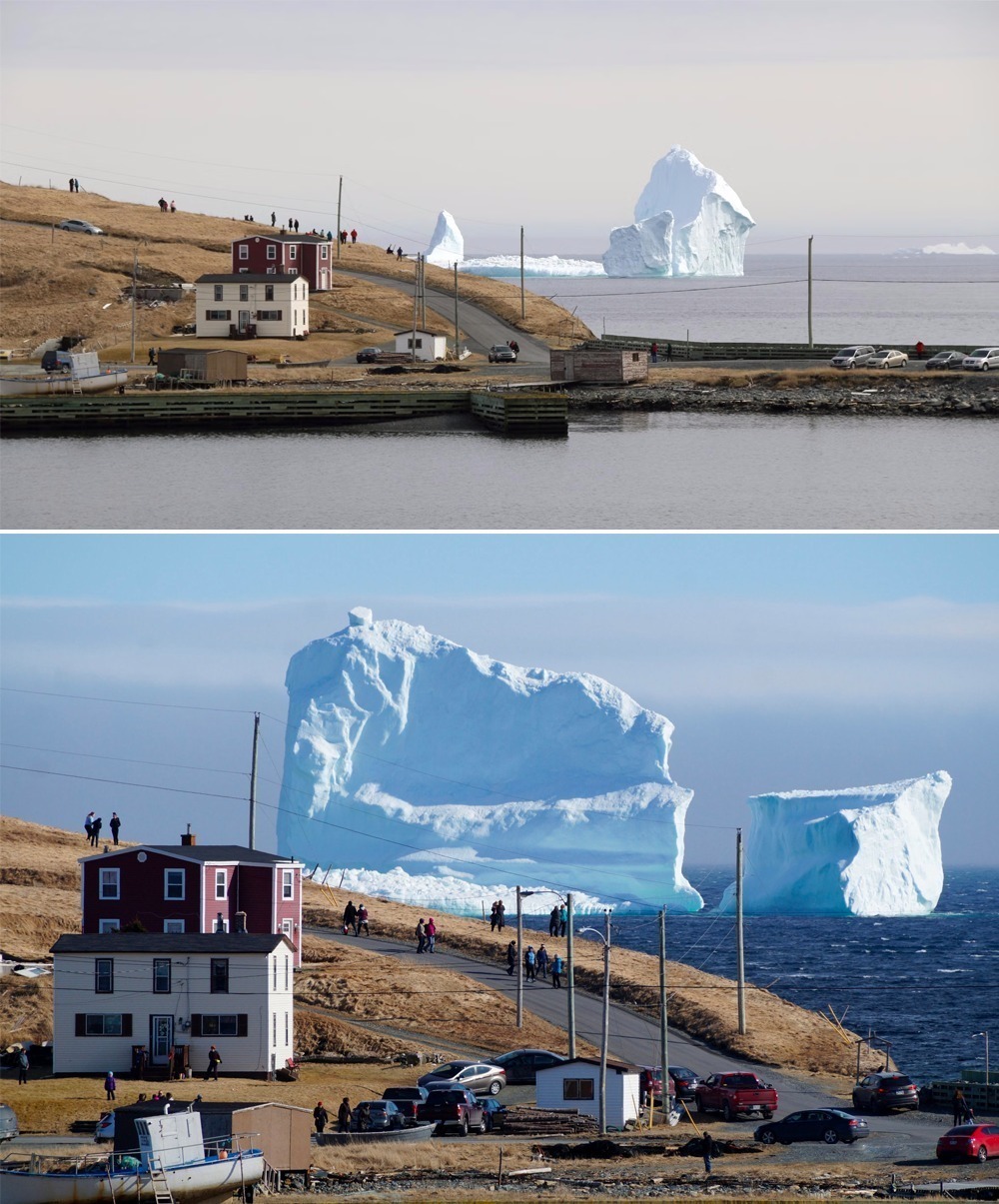
Stretching from the Arctic to the southeast coast of Newfoundland, Canada, Iceberg Alley is a natural wonder that draws visitors and locals alike. Here, massive icebergs drift past the island, offering a spectacular sight that can even be enjoyed from the comfort of your kitchen window while preparing the local staple, Jiggs dinner.

Iceberg Alley is home to hundreds of icebergs every year, particularly during the spring when surrounding sea ice melts, making these frozen giants even more dramatic. Most of these icebergs originate far to the north, primarily from Greenland. Each spring and summer, chunks of glaciers break off into the ocean, beginning a slow journey southward. Guided by ocean currents, they travel through Baffin Bay toward the Labrador Sea, eventually reaching the eastern and western shores of Newfoundland. A smaller number of icebergs are calved from Canadian glaciers, following a similar path from Baffin Bay through the David Strait.

These enormous ice masses are ancient, often around 10,000 years old. Between 400 and 800 of them drift through Iceberg Alley each year, moving at an average pace of 0.4 miles per hour. Their speed varies depending on factors such as size, shape, wind, currents, and waves. Despite their apparent size, only about 10 percent of an iceberg is visible above the water, with the vast majority hidden below the surface—a literal “tip of the iceberg.”

Icebergs in Iceberg Alley come in six distinct types. According to Atlas Obscura, tabular icebergs are flat slabs, much wider than they are tall. Blocky icebergs have steep, angular sides, resembling truncated pyramids, while wedged icebergs feature one steep and one sloping side. Dome icebergs are rounded on top, and pinnacle icebergs have one or more pointed peaks. Finally, dry dock icebergs are U-shaped. This diversity makes each iceberg unique and awe-inspiring.

Viewing icebergs up close can be mesmerizing, but it also comes with risks. Icebergs are unpredictable and potentially hazardous, especially from the water. Experts recommend keeping a safe distance equal to the length of the iceberg or twice its height, whichever is greater. Within this perimeter, dangers include falling ice, waves generated by shifting ice, and hidden underwater hazards. Historical events, like the Titanic disaster off Newfoundland in 1912, serve as sobering reminders of the threat posed by these drifting giants.

As icebergs move south into warmer waters, they gradually melt, becoming more unstable and dangerous. Today, satellite technology allows for tracking medium and large icebergs, but smaller ones often go unnoticed, posing risks for smaller vessels. Despite these dangers, sightings of massive icebergs continue to capture the public’s imagination. One notable example occurred in 2017 when a towering iceberg drifted beside a tiny Newfoundland town, completely dwarfing it and drawing international attention. Its iconic presence was even commemorated on a Canada Post stamp, photographed by Michael Winsor.

Iceberg Alley is more than just a scenic location—it’s a living reminder of the power and beauty of nature. From ancient glaciers in Greenland to the shores of Newfoundland, each iceberg carries with it thousands of years of history. While some melt away quickly, their images live on in photographs, postcards, and stamps, preserving the memory of these magnificent natural sculptures. For those lucky enough to witness them, whether from a boat, a coastal lookout, or a kitchen window, Iceberg Alley offers a truly unforgettable experience.

In every season, the drifting icebergs of Newfoundland’s waters tell a story of movement, time, and natural grandeur. From the colossal forms that dominate the horizon to the delicate patterns etched into their surfaces, Iceberg Alley is a testament to the enduring allure of the north Atlantic and the enduring fascination humans have with these floating giants.


Post Comment