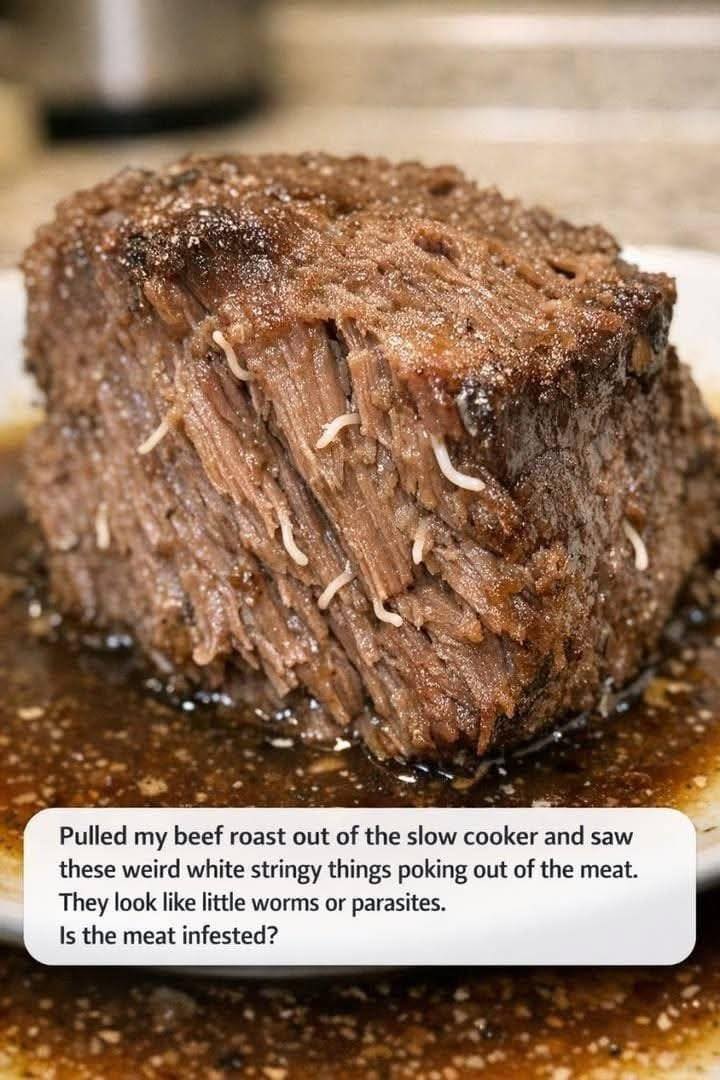
Pulled my beef roast out of the slow cooker and saw these weird white stringy things poking out of the meat. They look like little worms or parasites. Is the meat infested? Full article in comment below
Why Are There White Stringy Things in My Slow Cooker Beef Roast?
You lift the lid on your slow cooker after hours of patiently waiting for your beef roast to become tender and flavorful. The aroma smells amazing—but then you notice something strange. Tiny white stringy pieces are sticking out of the meat. Suddenly, your appetite disappears.
Many people immediately worry that these odd-looking strands are worms, parasites, or signs the meat has gone bad. Fortunately, in almost every case, those white stringy bits are completely normal and harmless.
The truth is far less alarming: what you’re seeing is usually softened connective tissue and collagen that naturally exists inside the beef roast.
What Are the White Stringy Pieces?
Beef contains more than just muscle. Inside every roast are connective tissues that help hold the meat together. These tissues are packed with collagen, a structural protein found in tendons, ligaments, and muscle fibers.
When beef cooks slowly over several hours—especially in a crockpot or slow cooker—the collagen gradually breaks down into gelatin. During this process, some parts of the connective tissue can become visible as pale, thread-like strands or soft white fibers throughout the meat.
While they may look unpleasant at first glance, they are actually one of the reasons slow-cooked beef becomes so tender and juicy.
Cuts commonly used in slow cooking, such as chuck roast, brisket, and rump roast, naturally contain large amounts of connective tissue. That’s why these cuts benefit from low, slow cooking methods.
Why Slow Cooking Makes Them More Noticeable
High-heat cooking methods like grilling or pan-searing cook meat quickly, leaving much of the connective tissue firm and less visible. Slow cooking works differently.
Over several hours at low temperatures, collagen slowly melts and loosens apart. As the meat fibers separate, these softened tissues can appear as thin white strands between the meat.
In fact, seeing these strands is often a sign that the roast has cooked properly and become tender.
Could They Actually Be Parasites?
For most people, this is the biggest fear. Thankfully, true parasites in commercially sold beef are extremely rare in countries with modern food safety systems and meat inspections.
In addition, parasites cannot survive proper cooking temperatures. Beef that reaches a safe internal temperature is considered safe to eat.
There are also some important visual differences between connective tissue and parasites:
| Connective Tissue | Parasites |
|---|---|
| Soft and slippery | Firm and defined |
| Irregular in shape | Uniform in appearance |
| Breaks apart easily | Maintains structure |
| Blends into meat fibers | Looks separate from meat |
If your roast smells fresh, looks normal aside from the strands, and was stored and cooked safely, there is little reason to worry.
What About Tendons and Silver Skin?
Some white stringy pieces may also come from tendons or “silver skin,” another type of connective tissue often found in tougher cuts of beef.
Silver skin is a thin, silvery membrane that doesn’t fully dissolve during cooking. In a slow cooker, parts of it may loosen and separate into stringy sections that become more noticeable once the meat is shredded.
Although edible, some people prefer to remove larger pieces because of their chewy texture.
How to Tell If Beef Has Actually Gone Bad
White strands alone are usually harmless. However, there are other signs that may indicate spoiled meat:
- Strong sour or rotten smell
- Sticky or slimy surface before cooking
- Green, gray, or rainbow discoloration
- Unusual mold growth
If you notice these warning signs, it’s best to throw the meat away.
Final Thoughts
Finding white stringy bits in your slow cooker beef roast can definitely be unsettling the first time you see them. But in most cases, they are simply collagen and connective tissue that have softened during the cooking process.
Far from being dangerous, these tissues are actually responsible for the rich texture and tenderness that make slow-cooked beef so delicious.
So if your roast smells normal, was handled safely, and cooked thoroughly, those strange-looking strands are almost certainly harmless—and proof that your slow cooker did exactly what it was supposed to do.





Post Comment