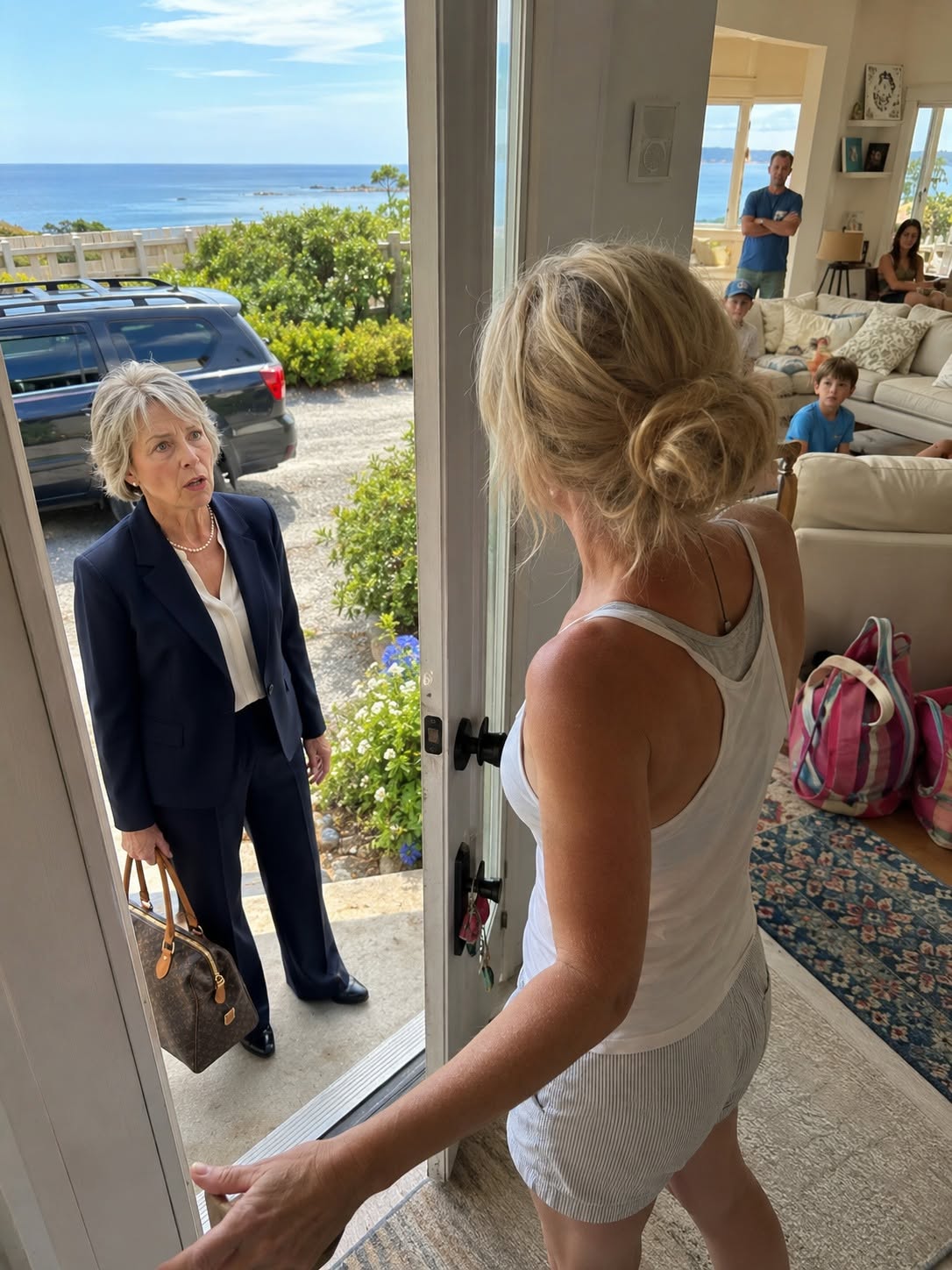
She arrived at her seaside home hoping to rest, and her daughter-in-law greeted her with an icy smile: “There’s no space for extra guests,” never imagining that the humiliation would expose a much darker betrayal. – Story
# She Arrived at Her Seaside Home to Rest. Her Daughter-in-Law’s First Words Changed Everything.
After an exhausting six-hour drive from Philadelphia, seventy-year-old Rosalind Hale wanted only two things: silence and sleep.
For years, her small seaside cottage on the Rhode Island coast had been her sanctuary. Every floorboard, every flower bed, and every piece of furniture represented years of sacrifice and hard work. After losing her husband, Winston, Rosalind had spent more than a decade sewing wedding dresses, repairing uniforms, and taking every alteration job she could find to save enough money to buy the property.
That little cottage wasn’t just a house.
It was her independence.
But when she arrived that cold January afternoon, something felt wrong.
Three unfamiliar SUVs lined the street. Children’s toys were scattered across her garden. Music blasted from inside the house.
Confused, Rosalind walked to the front door and knocked.
When it opened, she found her daughter-in-law Tiffany standing there wearing Rosalind’s favorite embroidered apron.
Tiffany smiled coldly.
“There’s no room for you here anymore, Rosalind. The house is full, and we don’t want any inconvenience.”
For a moment, Rosalind thought she had misheard.
Then she looked past Tiffany and saw strangers everywhere. Tiffany’s relatives lounged on her furniture. Someone else’s belongings filled her living room. Her carefully maintained home had been transformed into someone else’s vacation rental.
Even worse, nobody seemed surprised to see her.
They had expected this confrontation.
Rosalind felt the humiliation immediately.
But instead of arguing, she simply nodded.
“All right,” she said quietly.
Then she turned around and left.
Tiffany’s relieved smile followed her all the way back to her car.
That night, Rosalind checked into a nearby hotel.
She couldn’t sleep.
The more she thought about what had happened, the less it felt like a misunderstanding.
Her son Peter knew she was arriving that day. She had texted him three days earlier and received confirmation. Yet somehow his wife had prepared a speech and changed the entire house without warning.
Something wasn’t right.
The next morning, Rosalind returned to the cottage.
That’s when she discovered something shocking.
Her key no longer worked.
The locks had been changed.
Standing on her own porch, staring at the new lock installed without her permission, Rosalind felt a chill run through her body.
This wasn’t about rude behavior.
This was planned.
Using an old side entrance, she quietly approached an open kitchen window.
Inside, she heard Tiffany speaking to her mother.
“Once the paperwork is filed, the rest is easy.”
“What if she fights?” her mother asked.
Tiffany laughed.
“Rosalind? Please. Peter says she hates conflict. By the time she realizes what’s happening, the conservatorship petition will already make her look unstable.”
Rosalind froze.
Conservatorship?
Then Tiffany continued.
“The house is worth millions now. Once we sell it, we’ll put her somewhere comfortable. A nice facility. She’ll be taken care of.”
Rosalind could hardly breathe.
Her son and daughter-in-law weren’t simply trying to use the house.
They were trying to take it permanently.
After Tiffany walked away, Rosalind quietly entered through the side door and found documents sitting beside the printer.
Real estate listings.
Property valuations.
And a conservatorship petition naming her son Peter as the applicant.
Most disturbing of all was a recently recorded deed transferring ownership of the cottage from Rosalind to Peter.
The signature looked like hers.
But she had never signed it.
Someone had forged the document.
Heartbroken but determined, Rosalind immediately contacted Mara Quinn, a trusted attorney and longtime friend.
Within hours, Mara uncovered the truth.
Peter was drowning in debt after a failed business investment. Facing financial ruin, he and Tiffany had decided the easiest solution was to steal Rosalind’s fully paid-off beachfront property.
The forged deed would transfer ownership.
The conservatorship would silence any objections.
And the sale of the house would solve their money problems.
At least, that was the plan.
Mara quickly obtained emergency court orders freezing all transactions involving the property. Authorities launched an investigation, and the fraudulent deed was challenged.
Two days later, Rosalind returned to the house with her attorney and law enforcement.
Tiffany’s confidence disappeared the moment she saw them.
Within hours, Tiffany’s entire family was packing their belongings and leaving.
Then Peter arrived.
When confronted with the evidence, he finally admitted everything.
He had helped create the fraudulent deed.
He had approved the conservatorship petition.
And he had allowed Tiffany to force his own mother out of her home.
“I was trying to fix things,” Peter said weakly.
Rosalind looked at him with tears in her eyes.
“No,” she replied. “You were trying to save yourself.”
The legal process took months, but the outcome was clear.
The forged deed was invalidated.
The sale was canceled.
The property remained entirely in Rosalind’s name.
Peter eventually sent a long letter apologizing for everything he had done. He admitted his mistakes, acknowledged his greed, and asked for forgiveness.
Rosalind read the letter carefully.
Then she placed it in a drawer.
She wasn’t ready to answer.
Today, she still lives in the seaside cottage she worked so hard to build.
Every morning she drinks tea while looking out over the Atlantic Ocean. The lavender she planted years ago still grows beside the porch. The embroidered apron hangs once again in her kitchen.
The house is quiet.
Peaceful.
And most importantly, it is hers.
Because after a lifetime of sacrifice, Rosalind finally learned something important:
Kindness is a strength.
But when people mistake kindness for weakness, sometimes the strongest thing you can do is refuse to surrender what you’ve spent your life building.






Post Comment