My son’s bully tormented him for two years until his biker father found out and showed up at our door at 10 PM. I saw the headlight first. – Story
For two years, my son lived in fear—the quiet, grinding kind that makes mornings unbearable and school hallways feel like traps. I didn’t realize how bad it was until the night a Harley rolled down our street at ten o’clock and stopped in front of our house.
The headlight hit first. Then the engine—a deep, heavy rumble. My husband grabbed the baseball bat hidden in the closet. “Stay inside,” he said. “If anything goes sideways, call 911.”
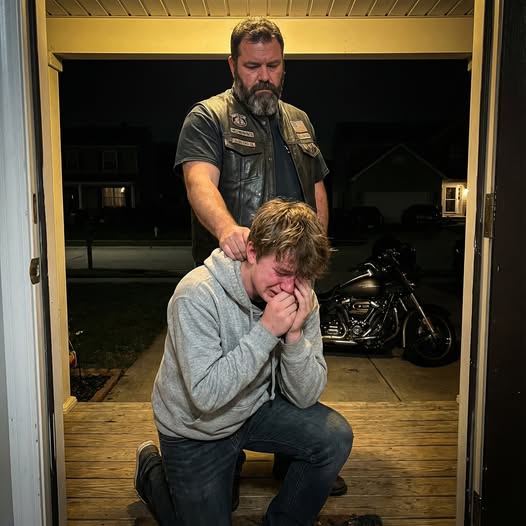
A massive man climbed off the motorcycle—leather vest, tattoos, intimidating presence. Behind him, a boy with hunched shoulders and red, swollen eyes. Tyler Morrison. Thirteen years old. The boy who had made my son Marcus dread every day since fifth grade.
The biker gripped Tyler by the neck and walked him up the driveway. My husband opened the door. “We don’t want trouble,” he said.
“I’m not here to cause trouble,” the man replied. “I’m here to end it.” Then he shoved Tyler forward.
Tyler fell to his knees on our porch. “Tell them everything,” the biker said. Tyler broke down immediately, sobbing, confessing the relentless bullying—the name-calling, shoving into lockers, destroying schoolwork, even telling Marcus no one would ever love him and he should kill himself. He admitted the fake Instagram account, the orchestrated cruelty that had kept my son trapped in fear.
The biker introduced himself: Dean Morrison, Tyler’s father. He admitted his own failures. “I taught him that strength means control. That power comes from making others feel small,” he said, voice cracking. “That ends tonight.”
Marcus, trembling, whispered, “Why me?” Tyler looked up: “Because hurting you made me feel powerful. And that’s the worst thing I’ve ever done.”
Silence. Then Marcus stood. “I don’t forgive you yet,” he said softly, “but I want to try.” He offered his hand. Tyler shook it.
Dean laid out a plan: weekly accountability at our house, therapy, public apology. No shortcuts. Words hadn’t caused the damage—actions had. Over weeks, Tyler worked under supervision. Gradually, walls fell. Conversations grew longer. By week twelve, Tyler presented Marcus with a drawing: “Friends > Enemies.”
Years later, Tyler stood on stage, owning his mistakes. “My dad didn’t protect me from consequences,” he said. “He protected me from becoming someone I couldn’t live with.”
That night changed everything—not because of fear, but because of responsibility. Strength doesn’t always look like fists or threats. Sometimes it looks like a father dragging his son to accountability, teaching him to face the harm he caused—and to become better.




Post Comment