You’re kidding me😯
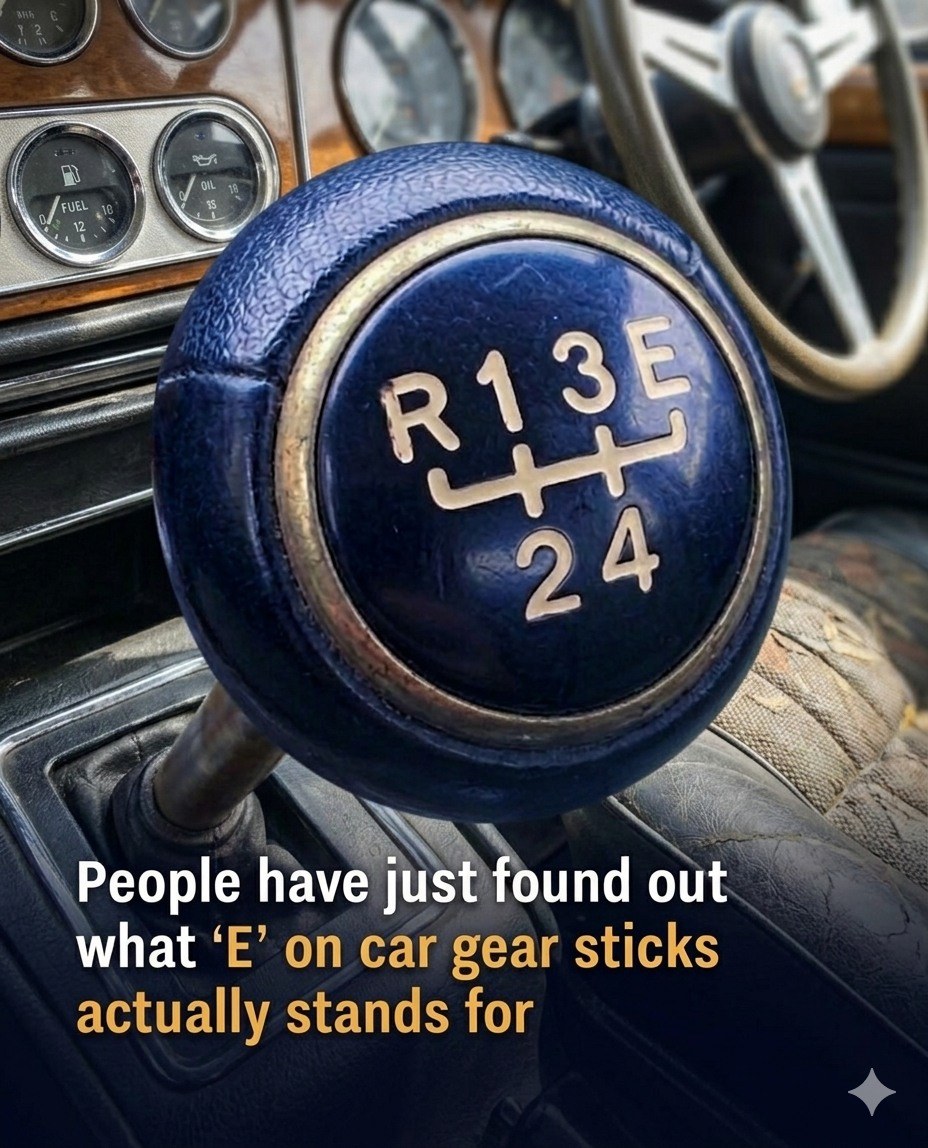
The interior of a modern automobile is a study in digital minimalism—a quiet, refined space defined by touchscreens, subtle haptic feedback, and carefully engineered silence. For drivers raised in an age of automation, the center console often appears almost empty, offering little more than a sleek dial or a minimal toggle to select direction. But for those who learned to drive in the late twentieth century, the experience was far more tactile. The gear shifter wasn’t just a control; it was a physical language of motion, where each letter and number represented a distinct mechanical state. Among the familiar “P” for Park and “D” for Drive, there was once another marking that has since faded into obscurity: the letter “E.”
To a driver in 2026, that single letter might seem puzzling, like a fragment of a forgotten system. Yet its meaning reflects a pivotal moment in automotive history—an era when efficiency was not automatic, but intentional. In the 1980s and early 1990s, the “E” stood for “Economy,” a mode shaped by the lingering impact of global fuel crises and rising gasoline costs. At the time, drivers were far more aware of the relationship between their actions and fuel consumption, and manufacturers responded by giving them direct control over efficiency.
Engaging “E” was not merely a symbolic act. It triggered a fundamental shift in how the car behaved. Early electronic control units or hydraulic transmission systems would adjust gear changes to occur at lower engine speeds, guiding the car into higher gears sooner. This reduced fuel consumption, softened engine noise, and encouraged smoother, more measured driving. Instead of aggressive acceleration and rapid gear changes, the vehicle favored consistency and restraint.
Driving in Economy mode required a subtle change in mindset. It discouraged sudden bursts of speed and minimized the sharp “kick-down” shifts used for overtaking. In some vehicles, throttle response was deliberately softened, meaning that even a firm press on the accelerator resulted in gradual acceleration rather than an immediate surge. In effect, the car gently trained the driver to be more efficient, acting almost like a mechanical advisor promoting restraint.
This hands-on approach to fuel efficiency reflected a time when technology assisted rather than replaced driver awareness. Choosing “E” was a conscious decision—a small but meaningful gesture that linked personal behavior to broader concerns about fuel use and cost. It gave drivers a sense of agency, allowing them to directly influence how their vehicle consumed resources.
As automotive technology evolved, the need for such manual intervention gradually disappeared. By the mid-2020s, the physical “E” on gear levers had largely vanished—not because efficiency was no longer important, but because it had become deeply integrated into the car’s design. Modern vehicles rely on advanced onboard computers capable of analyzing vast amounts of data in real time, from driving patterns to environmental conditions. These systems continuously optimize performance, adjusting gear shifts, fuel delivery, and power output without requiring driver input.
With innovations such as high-precision fuel injection, multi-speed transmissions, and continuously variable gear systems, efficiency is now automatic. The car itself determines the most economical way to operate, rendering a dedicated “Economy” gear unnecessary. What was once a deliberate choice has become a constant, invisible process.
This shift reflects a broader transformation in how humans interact with machines. Where drivers once engaged directly with mechanical systems, they now rely on algorithms that operate quietly in the background. The tactile feedback of a gear lever has been replaced by digital interfaces and software-driven decisions. Efficiency is no longer something the driver activates—it is something the car inherently provides.
Interestingly, the letter “E” has not disappeared entirely. Instead, it has taken on new meaning in the era of electric vehicles. Today, “E” often refers to “Electric” modes or features such as enhanced regenerative braking, where the vehicle recaptures energy during deceleration. In this context, the letter represents not just efficiency, but a fundamental shift away from traditional fuel altogether.
The journey of the “E” from “Economy” to “Electric” mirrors the evolution of the automotive industry itself. It connects a past defined by mechanical awareness and manual control with a present shaped by automation and sustainability. What was once a simple gear selection has become a symbol of technological progress.
Looking back, the presence of “E” on older gear sticks serves as a reminder of a different driving philosophy—one where efficiency required intention and participation. Its disappearance highlights how far automotive engineering has come, transforming efficiency from a driver’s choice into a built-in standard.
Yet the spirit behind that letter endures. The goal it represented—doing more with less—remains central to modern innovation. Whether through hybrid systems, electric drivetrains, or advanced software, the pursuit of efficiency continues to shape the future of transportation. The “E” may no longer occupy a physical place on the gear shifter, but its legacy lives on in every vehicle designed to travel farther, cleaner, and smarter than ever before.






Post Comment