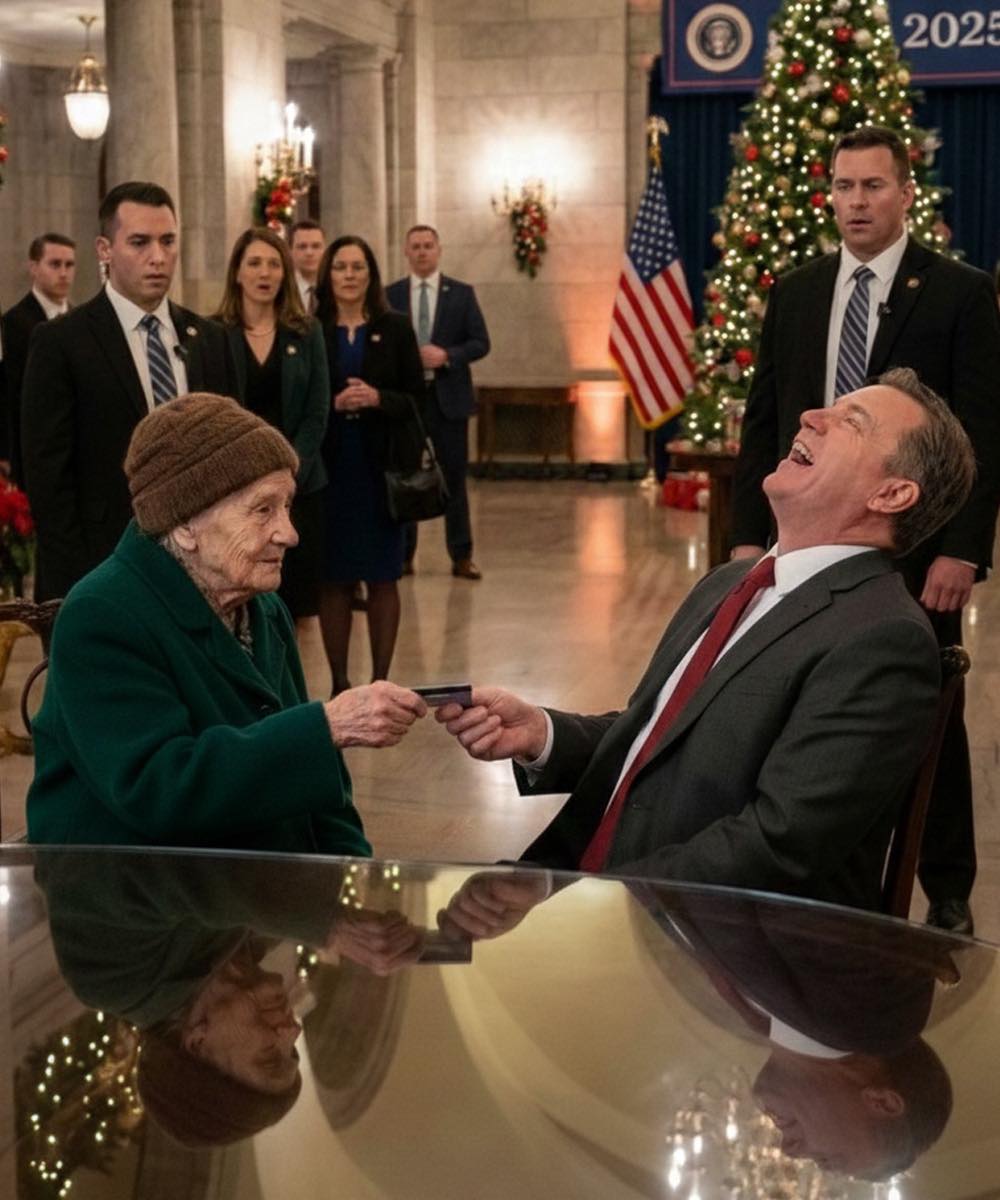
“I Just Want to Check My Balance,’ Said the 90-Year-Old Woman — The Millionaire Laughed… Until He Saw This – Story
“I’d like to check my balance,” the 90-year-old Black woman said quietly.
Her voice trembled just enough to carry across the polished marble lobby of First National Bank. Conversations slowed. A few customers glanced over; others smirked. At the center of it all stood Charles Hayes, the bank’s president—impeccably dressed, confident, accustomed to power.
He let out a sharp laugh.
“Ma’am,” he said loudly, ensuring the room could hear, “this is a private bank. The neighborhood branch down the street may be more appropriate.”
The woman rested both hands on her cane. Her coat was plain, her shoes worn, but her eyes were steady.
“Young man,” she replied evenly, producing a black card from her purse, “I asked to check my balance. Not for directions.”
Charles examined the card with open disdain. The edges were scuffed; the print faded.
“Janet,” he called to his assistant, “another fake card.”
A few customers chuckled.
Janet leaned closer. “Sir, we could verify it in the system.”
“I won’t waste time,” Charles snapped.
He gestured for security.
Two guards approached, uneasy. “Ma’am, we’ll have to escort you out.”
The woman didn’t move.
“I’m not leaving,” she said softly. “I want to check my balance.”
A wealthy customer nearby whispered, “Probably Alzheimer’s.”
Then the woman laughed. Deep. Certain.
“Alzheimer’s?” she said. “That’s interesting. Because I remember cleaning your grandfather’s office in 1955, Mr. Hayes.”
Silence fell.
Charles stiffened. His family had owned the bank for decades.
“You were fifteen,” she continued. “I worked fourteen-hour days after school. Your grandfather used to leave lit cigarettes on the marble floor to see if I’d complain.”
Her gaze locked onto his.
“I never did. We needed the money.”
Charles swallowed. “Anyone could make that up.”
“He had a scar on his left hand,” she said calmly. “From the day he tried to smash a glass over my head. Missed. Cut himself. Told everyone it was gardening.”
The room seemed to shrink.
Before Charles could respond, the main doors opened. Gerald Simmons, senior vice president and founding board member, strode in.
“Charles,” Gerald said coolly, “why can I hear you from upstairs?”
Charles began explaining, but Gerald walked past him—straight to the woman.
“Margaret,” he said warmly, “it’s good to see you. Is there a problem?”
Shock rippled through the lobby.
“She believes I don’t belong here,” Margaret said gently.
Gerald’s expression hardened. “My office. Now,” he told Charles.
Minutes later, Janet returned with a tablet.
“Mrs. Margaret, would you like to review your account privately?”
Margaret shook her head. “Right here. Transparency matters.”
Janet read the balance aloud.
Eight hundred forty-seven thousand dollars.
Then additional accounts.
Investments.
Trusts.
Nearly nineteen million in total.
The whispers stopped.
When Charles returned, pale and shaken, Gerald ordered him to apologize.
Margaret stood before him.
“Didn’t know what?” she asked softly. “That I had money—or that dignity doesn’t depend on it?”
She revealed she had recorded the entire exchange.
By evening, Charles Hayes was suspended pending investigation.
Six months later, Margaret Johnson was appointed to the bank’s board—the first Black woman in its history.
Charles was gone.
Under Margaret’s influence, the bank expanded community scholarships, revised hiring practices, and established policies rooted in equity rather than image.
She continued visiting the marble lobby—not to check balances, but to interview scholarship candidates and mentor young employees.
People often asked why she had come in person that day instead of using online banking.
Margaret would simply smile.
“Sometimes,” she’d say, “you don’t check your balance to see what you have. You check it to see who believes you deserve it.”
In the end, the marble floors remained polished, the chandeliers still shimmered.
But something had shifted.
Because that day, in a room built to intimidate, dignity walked in on a cane—
—and walked out owning the future.





Post Comment