The Day Everything Changed Between a Father and His Child
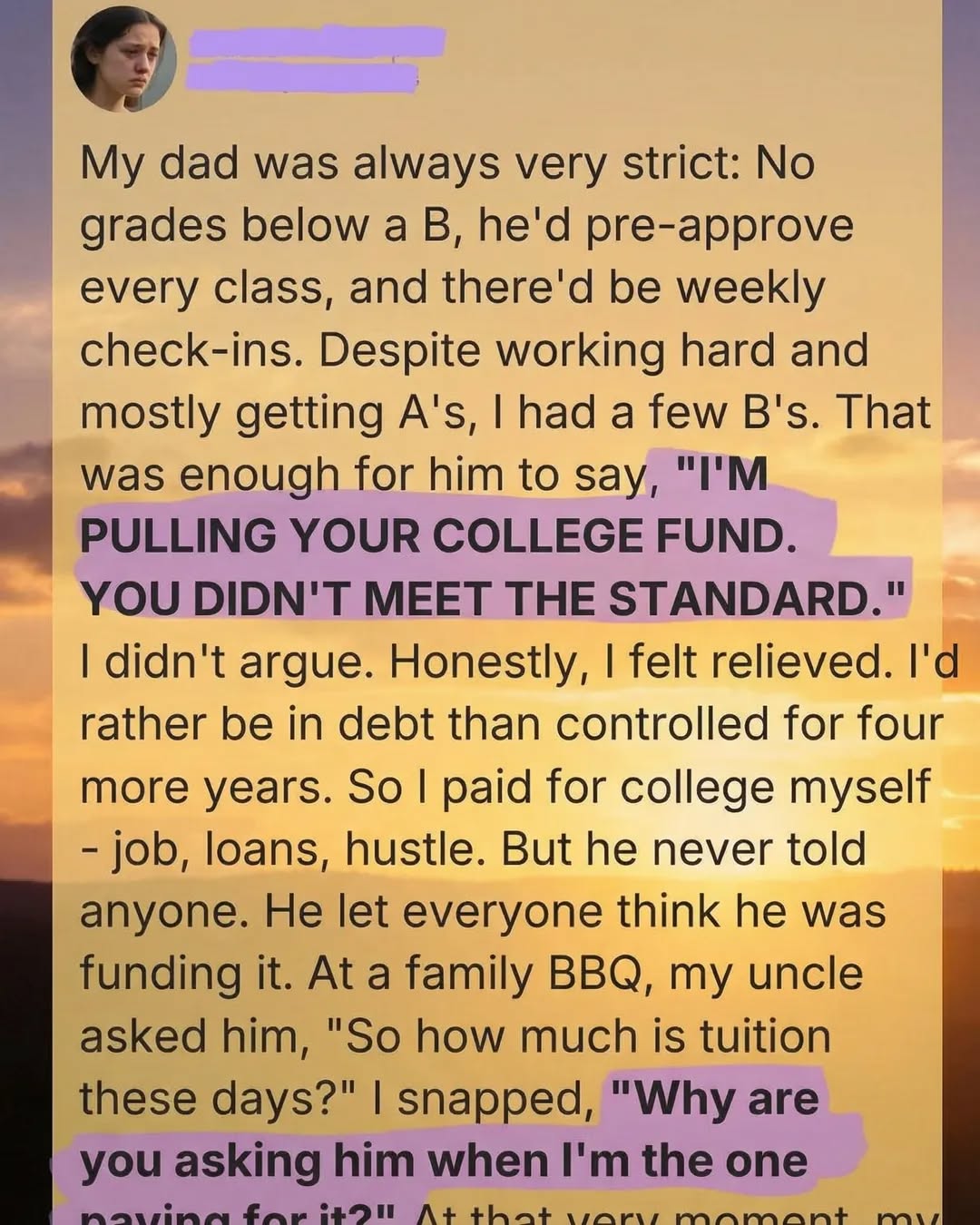
My dad was always extremely strict. No grades below a B, no choosing my own classes without his approval, and weekly check-ins to make sure I stayed on track. Even though I worked hard and earned mostly A’s, the few B’s I did get were enough for him to declare, “I’m pulling your college fund. You didn’t meet the standard.” I didn’t argue. Strangely, a part of me felt relieved. Life under his rules had always felt like walking a tightrope where the slightest wobble counted as failure. Losing the college fund hurt, but it also meant I could finally make choices for myself without trying to meet his impossible expectations.
So I paid for school on my own—working long shifts, taking out loans, and learning to stretch every dollar. The journey was difficult, but each struggle belonged wholly to me. For the first time, my achievements were mine alone.
What stung more than losing the financial support was what came next. My dad never told the family the truth. He let everyone believe he was the one funding my education, still playing the role of the responsible, supportive parent. At a family barbecue, when my uncle casually asked about tuition, years of swallowed frustration finally cracked through. “Why are you asking him when I’m the one paying for it?” I said. The silence that followed was suffocating. My dad’s narrowed eyes didn’t show anger—more something like fear. For him, it was never about the money. It was about the image, the narrative he needed to control.
The weeks after were tense and quiet, but in that silence I gained clarity. Independence wasn’t just paying my own bills; it was rewriting the story I’d been raised in. I no longer wanted to be the child trying to earn approval. I wanted to be someone defined by resilience, not pressure—by my own choices, not obligation. And the stronger I became, the less certain my dad seemed about how to relate to me. Ironically, he had raised me to be disciplined and determined, but now those traits no longer answered to him.
Years later, after graduating, I invited him for coffee—not out of duty, but out of peace. He looked older, still proud but softer. We talked about work, the future, and eventually the past. When I thanked him—not for the pressure, but for unintentionally pushing me to build my own life—he finally exhaled, as if releasing a breath he’d been holding for decades.
We’ll never agree on everything, and that’s okay. Families don’t need perfection to heal. What matters is that, for the first time, our relationship is built on honesty—painful, imperfect, but real.






Post Comment