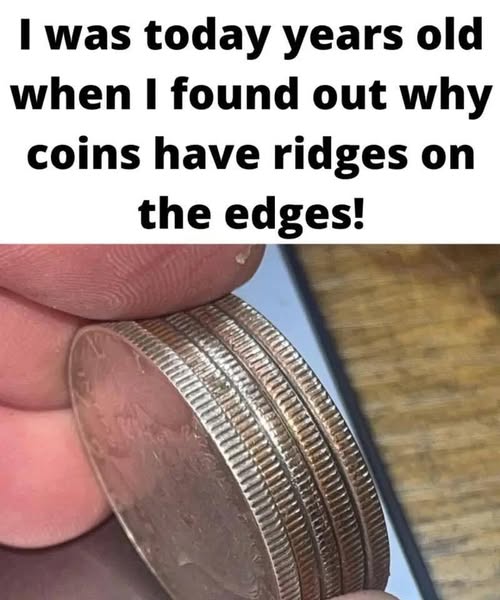
Why coins have ridges🤯😮 on the edges!
Coins move through our hands so often that we rarely question their physical features. Yet the ridged edges found on many coins are no accident—they were designed to solve a very real historical problem. In earlier centuries, coins were made from precious metals like gold and silver, meaning their value was tied directly to their weight and purity. This created an opportunity for clipping, a practice where small amounts of metal were shaved off the edges to be sold separately. Over time, widespread clipping eroded the weight and trust in coins, destabilizing economies and undermining confidence in currency.
Early attempts to combat clipping included harsh punishments, public warnings, and re-minting campaigns, but these measures addressed symptoms rather than the root cause. A more effective solution was a physical deterrent built into the coin itself. By introducing uniform ridges along coin edges, any tampering became immediately visible. A shaved coin would disrupt the pattern, alerting merchants and officials to fraud. This approach transformed oversight from complex investigation to simple observation, allowing anyone to detect alterations at a glance.
Isaac Newton, as Warden and later Master of the Royal Mint in England, championed this innovation in the late seventeenth century. He oversaw the production of coins with precise weight and reeded edges, making tampering obvious and standardizing currency across England. His work not only addressed technical issues but reinforced the philosophical idea that currency should be reliable and transparent. Newton’s reforms influenced mints across Europe, embedding ridged edges into global monetary systems.
Over time, ridged edges became a symbol of trust. Merchants could accept coins with confidence, and governments reduced costly re-minting cycles. Even as coins shifted from precious metals to alloys, the ridges remained. They continued to convey reliability and integrity long after clipping ceased to be a threat.
Today, ridged edges serve practical purposes beyond their original intent. Machines use them to identify denominations, and visually impaired individuals rely on the tactile cues they provide. They also prevent slippage and aid handling.
More than decoration, coin ridges are a link to history, a testament to human ingenuity in solving systemic problems, and a reminder that small design choices can have lasting, meaningful impact.






Post Comment