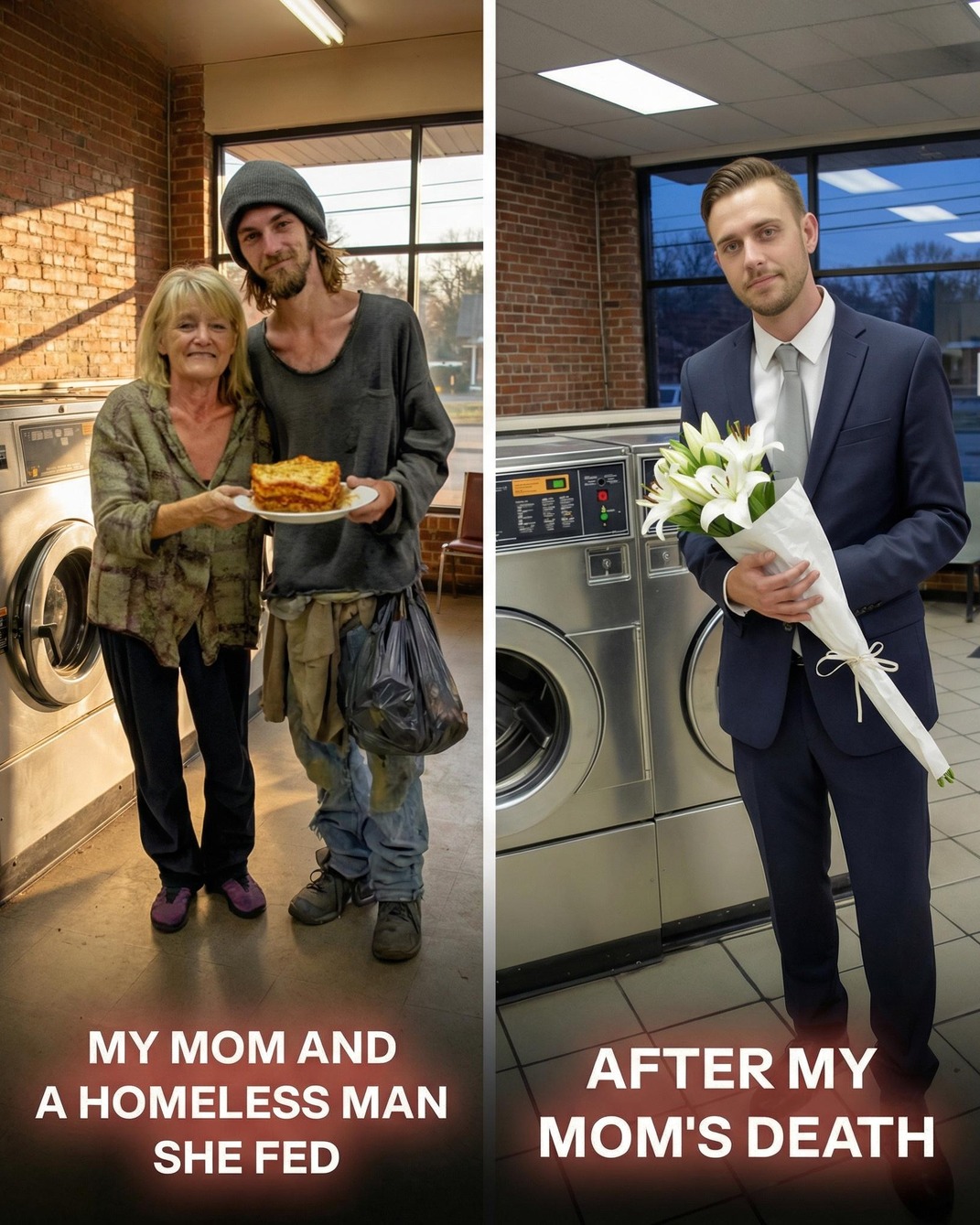
Every Christmas Eve, my mom cooked a big spread. Honey-glazed ham, mashed potatoes, green beans with bacon, a pan of cornbread that made the whole apartment smell like comfort. And no matter what was happening in our lives, she always SET ASIDE A SECOND PLATE. – Story
Every Christmas Eve, my mother followed a tradition that never appeared in family photos or holiday cards. She would cook a special dinner, filling our small apartment with the scent of roasted meat, buttered potatoes, and fresh cornbread. But one plate was always wrapped carefully in foil and placed in a grocery bag. When I was young, I finally asked who it was for. She simply said it was for someone who needed it.
That someone was Eli, a quiet young man who spent his nights in the corner of our local laundromat. While dryers hummed and fluorescent lights flickered overhead, he would sit with a worn backpack at his feet, reading old paperbacks or staring thoughtfully out the window. My mother never spoke down to him or asked prying questions. She would kneel beside him, hand him the warm meal, and offer a gentle smile, as though she were greeting an old friend.
Over time, I realized her kindness was not about charity—it was about dignity. She didn’t treat him like a project or a problem to solve. She treated him like a person.
As I grew older, Eli became a quiet fixture in our Christmas routine. He never asked for anything, yet my mother continued to show up. Slowly, pieces of his story surfaced in fragments: a childhood that moved between foster homes, a younger sister he’d tried to protect, her sudden passing from illness. He spoke carefully, never lingering too long on painful details. My mother listened without interrupting, her eyes steady and compassionate.
Some years she tucked gloves or thick socks into the grocery bag. Once, she mentioned a housing program she’d heard about and offered to help him apply. He declined gently, explaining he didn’t want to feel indebted or pitied. She nodded and never pressed him again. “Help doesn’t have to mean control,” she told me later. “Sometimes it just means showing up.”
I didn’t fully understand her quiet persistence then. But I watched how Eli’s guarded posture softened over the years, how he began greeting us with a small smile before she even spoke. Trust, I learned, is built in moments too small for most people to notice.
Then illness took my mother far sooner than anyone expected. The following December felt hollow. Decorations stayed boxed, and the apartment seemed too still without her humming in the kitchen. On Christmas Eve, I stood in front of the stove, unsure whether I had the strength to continue her tradition. For a moment, I considered letting it end with her.
But the thought of someone waiting—of an empty corner in a laundromat—pushed me forward.
I cooked a simple meal, wrapped it carefully in foil, and placed it in a grocery bag the way she always had. The laundromat looked the same, but when I stepped inside, I stopped in surprise.
Eli stood near the entrance, dressed in a neat suit, holding a bouquet of white lilies. He looked older, steadier. When he saw me, his eyes filled with tears.
“She helped me more than you know,” he said softly. Years earlier, my mother had quietly connected him with community programs—job training, counseling, support groups—never announcing her efforts, never seeking credit. He had found stable work, an apartment, and a sense of belonging. Before she passed, he promised her he would return one Christmas to show her he was okay.
“I guess I’m a little late,” he added, voice trembling.
We sat together, and he shared something I’d never known. Years ago, when I was eight, I’d wandered away at a crowded fair. It was Eli who found me crying near a food stand and walked me safely to a police officer before disappearing into the crowd. My mother had recognized him later at the laundromat and never forgotten that quiet act of protection. That was why she first approached him—with gratitude.
From his jacket pocket, he pulled an old photograph of that day, edges worn but carefully preserved. Seeing it felt like discovering a hidden thread that had always tied our lives together.
Later, we visited my mother’s resting place. Eli laid the lilies gently beside her name. The winter air was cold, but I felt something warm settle inside me.
Her kindness had never truly ended. It had simply grown—into second chances, into quiet strength, into a tradition that now belonged to both of us.
That night, I understood what she had been teaching me all along: love given freely does not disappear. It multiplies, often in ways we may never fully see.






Post Comment