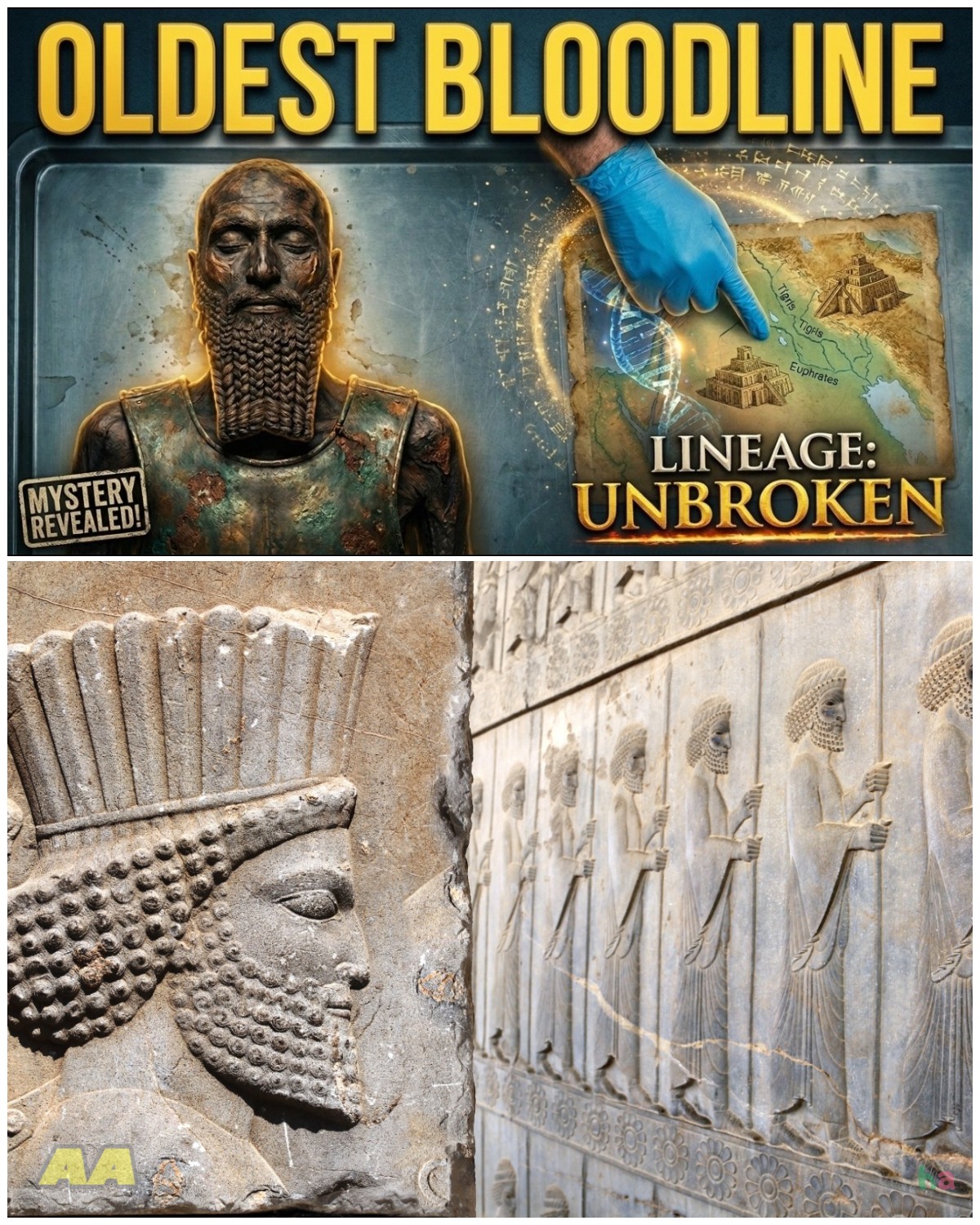
Assyrian DNA Just Revealed the Oldest Living Bloodline – s
The Bloodline That Endured: How the Assyrians Survived 4,000 Years of History
Long before modern nations took shape, the Assyrian Empire stood as one of the most powerful civilizations the world had ever known.
Stretching from the Nile to the mountains of Persia, it built cities of immense scale, including Nineveh, and established some of the earliest centers of knowledge in human history.
Yet while the empire itself fell in 612 BCE, its people did not disappear into the pages of history as many others had.
thumbnail
Instead, a continuous line of descendants persisted, carrying forward not only cultural traditions but a genetic identity that modern science is only now beginning to fully understand.
The origins of this lineage trace back to the Fertile Crescent, a region widely recognized as the cradle of civilization.
Here, between the Tigris and Euphrates rivers, early human societies transitioned from hunting and gathering to agriculture, laying the foundation for settled life.
Who are the Assyrians? | Live Science
These early farmers carried distinct genetic markers, particularly haplogroups J, G, and L, which have been identified in both ancient remains and modern populations.
Remarkably, these same markers continue to appear in the DNA of present-day Assyrians, linking them directly to some of the earliest agricultural communities in human history.
This connection is not based on legend or tradition alone, but on measurable genetic continuity supported by modern research.
Who are the Assyrians? | Live Science
In the late twentieth century, pioneering geneticist Luigi Luca Cavalli-Sforza conducted large-scale studies that mapped genetic variation across populations.
His findings revealed a distinct cluster within West Asia, one that included Assyrian populations and closely aligned with ancient genetic signatures from early farming communities.
This clustering demonstrated a level of genetic homogeneity that is unusual in a region characterized by centuries of migration, conquest, and cultural exchange.
Who are the Assyrians? | Live Science
The question then arises: how did this continuity persist through thousands of years of upheaval and change?
The answer lies not only in geography, but in culture, language, and social structure that reinforced a strong sense of identity.
Assyrian communities maintained strict traditions of endogamy, encouraging marriage within the group and limiting genetic mixing with surrounding populations.
These practices were reinforced by religious institutions and cultural norms that emphasized continuity and preservation of identity.
Who are the Assyrians? | Live Science
Language also played a crucial role, with forms of Aramaic continuing to be spoken and used in religious contexts across generations.
In isolated mountain regions, these linguistic traditions acted as a barrier against assimilation, preserving both cultural and genetic distinctiveness.
Geography further contributed to this isolation, as remote highland communities remained relatively insulated from external influences for extended periods.
Who are the Assyrians? | Live Science
Together, these factors created a form of resilience that allowed the Assyrian population to maintain continuity despite external pressures.
However, this continuity faced one of its greatest challenges during the Assyrian Genocide, also known as Sayfo.
During this period, widespread violence and forced displacement resulted in the deaths of hundreds of thousands of Assyrians and the fragmentation of their homeland.
Survivors were scattered across the Middle East and eventually across the globe, forming diaspora communities in cities far from their ancestral lands.
Who are the Assyrians? | Live Science
Despite this dispersion, genetic studies have shown that key markers remained consistent among these populations.
Research examining mitochondrial DNA has identified specific signatures that persist across geographically distant Assyrian communities.
These findings indicate that, even after displacement, the genetic identity of the population remained remarkably stable.
One such marker, found in a significant portion of both historical and modern samples, suggests continuity in maternal lineages spanning generations.
Who are the Assyrians? | Live Science
This level of preservation is particularly notable given the scale of disruption experienced during the early twentieth century.
Beyond individual markers, broader genomic analysis has revealed unique components within the Assyrian genetic profile that are not widely shared with neighboring populations.
These elements reinforce the idea that Assyrians represent one of the most genetically continuous groups in the region.
The persistence of these traits challenges assumptions about how populations evolve and adapt over long periods of time.
Who are the Assyrians? | Live Science
It also highlights the role of cultural practices in shaping genetic outcomes, demonstrating how social structures can influence biological continuity.
Today, Assyrian communities exist around the world, maintaining connections to their heritage through language, religion, and shared history.
Their story is one of survival not only through resilience, but through a complex interplay of factors that preserved their identity across millennia.
Who are the Assyrians? | Live Science
Modern genetic research has provided a new lens through which to view this history, offering evidence that complements archaeological and historical records.
Together, these sources paint a picture of continuity that is both rare and deeply significant in the study of human populations.
The Assyrian experience underscores the enduring impact of early human migrations and the lasting connections between past and present.
Who are the Assyrians? | Live Science
It also raises broader questions about identity, belonging, and the ways in which history is carried forward through both culture and biology.
As science continues to explore the genetic landscape of humanity, stories like this reveal just how deeply the past remains embedded within the present.
In the case of the Assyrians, that past is not distant or abstract, but alive in the people who continue to carry it forward today.






Post Comment