My Son Asked Everyone to Look at the Puddle, and It Saved My Father’s Home
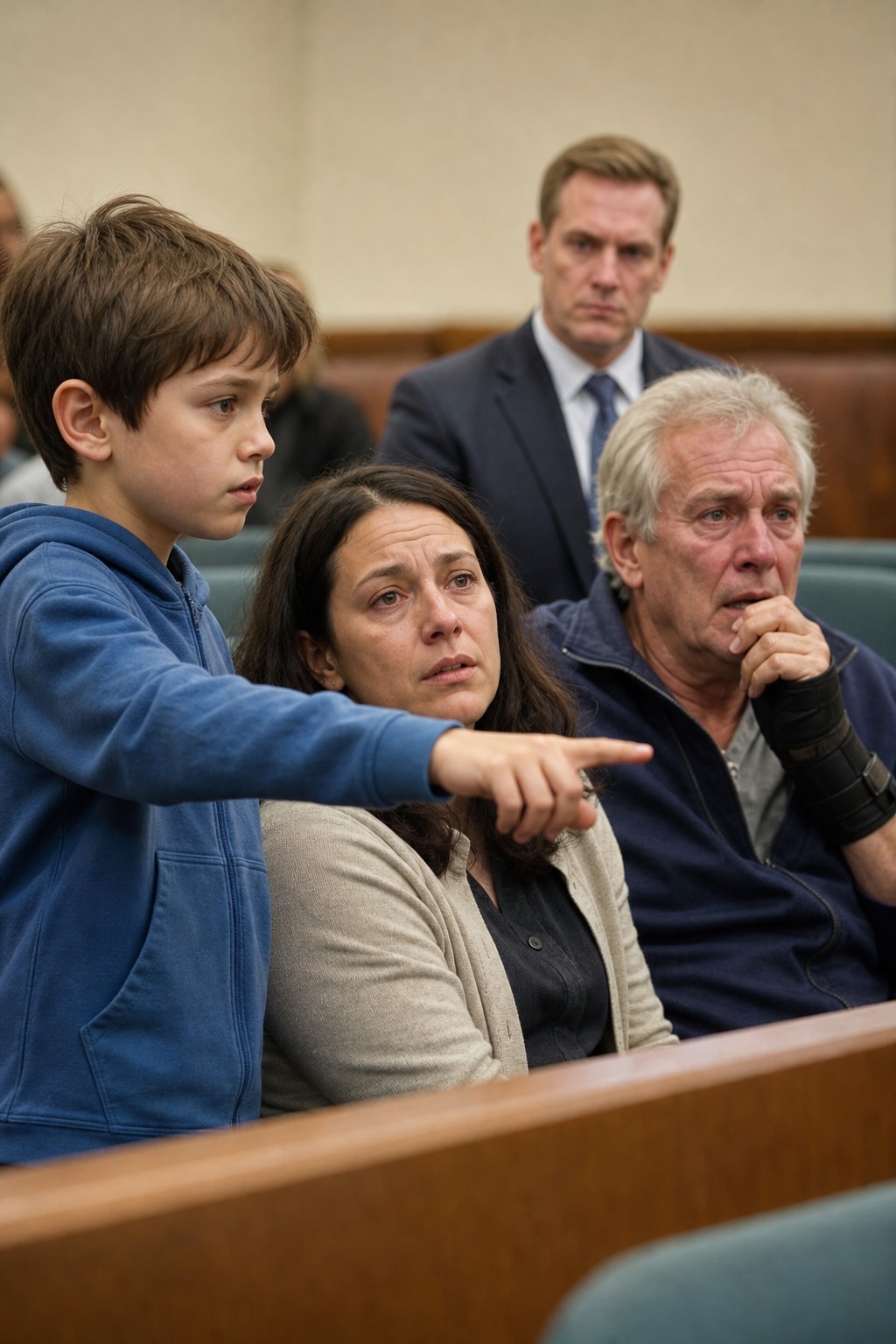
My nine-year-old son was supposed to be coloring quietly when he stood up in a county courtroom and said, “Excuse me. You’re all looking at the wrong thing.”
The judge paused with her pen in the air. My brother Mark made a soft, embarrassed laugh like Leo had told a joke at church.
“Buddy,” Mark whispered from the row behind us, “sit down.”
But Leo didn’t sit. He held my old phone in both hands, his knuckles pale, and pointed at the frozen video on the screen at the front of the room.
“Not Grandpa,” he said. “Look at the puddle by the trash cans.”
Every adult in that room had watched the same grainy porch camera footage three times. My father stepping into the rain. My father slipping near the back steps. My father’s cane lying too far away to help him.
We had all stared at Dad.
Leo had stared at the puddle.
And in that gray little mirror of rainwater, almost hidden under the shaking reflection of a porch light, was the shape of a man in a navy jacket moving my father’s cane.
My brother stopped laughing.
Before the Rain
My name is Claire Bennett. I was thirty-six then, a dental office receptionist in Marrow Bay, Oregon, a town where the rain had opinions and everyone knew which cashier at Harlow’s Market would double-bag your eggs without being asked.
I lived in a two-bedroom apartment above a laundromat with my son, Leo. Our kitchen always smelled faintly like dryer sheets from downstairs, and every spoon in the drawer had tiny dents because Leo liked to test which ones made the best bell sound against a mug.
Leo noticed things other people walked right past.
He noticed when the laundromat owner changed detergent brands because “the hallway smells more like fake lemons than clean towels.” He noticed when my left front tire was low before I did. He noticed that my father always stirred coffee six times clockwise and once backward, “like a period at the end of a sentence.”
He was not loud about it. That was why people missed Leo’s noticing.
They thought he was shy. They thought he was dreamy. They saw a thin boy with brown hair falling into his eyes, carrying a little sketchbook and a pencil sharpened down to a nub.
My father saw him clearly.
“That boy’s got a lighthouse in his head,” Dad used to say. “Keeps sweeping the beam where the rest of us forgot to look.”
Dad’s name was Joseph Bennett, but everyone called him Joe. He was sixty-nine, a retired ferry mechanic with hands that looked permanently dusty even after he washed them. He lived in the blue house on Alder Street, the one my mother had painted the summer before she got sick.
Mom had died two years earlier, and after that, the house became both a comfort and a wound.
Her raincoat still hung in the mudroom. Her handwriting still labeled jars in the pantry. Her reading glasses sat in a chipped bowl by the sink, though none of us knew why Dad couldn’t bring himself to move them.
My older brother Mark hated the house.
“It’s too much for him,” he said at least once a week. “Roof’s old. Steps are slick. Furnace is ancient. He’s rattling around in there with ghosts.”
Mark was forty-two, a real estate agent with perfect teeth and a phone always faceup on the table, as if the next call might crown him king of something. He wore fitted jackets and expensive shoes that looked strange on Dad’s worn linoleum.
I knew he cared about Dad in his way. I still believe that, even after everything.
But Mark liked problems that turned into paperwork. Houses could be listed. Debts could be refinanced. Feelings could be scheduled between appointments.
My father had a different pace. He fed the neighbor’s cat, Mrs. Wicks, even though the cat belonged two doors down. He listened to baseball on an old radio in the garage. He took three days to repair a birdhouse because, as he told Leo, “Rushing is how you teach wood to split.”
Dad was forgetful sometimes. He called me by my mother’s name once when he was tired. He put his reading glasses in the freezer and found them laughing at himself. He forgot a dentist appointment at my office, which annoyed my boss more than me.
But grief makes people foggy. That is not the same as being incapable.
Mark disagreed.
“You’re sentimental,” he told me one Tuesday evening at Dad’s kitchen table while Dad was in the garage showing Leo how to clamp a piece of cedar. “You want the old version of him, Claire. I’m looking at what’s actually happening.”
“What’s actually happening is he misses Mom.”
Mark leaned back and rubbed his forehead. “And he left the stove on.”
“The burner was on low under a pot of soup.”
“With no one in the kitchen.”
“He was in the bathroom for two minutes.”
“You don’t know that.”
I looked toward the garage, where Leo’s quiet voice floated in through the cracked door.
“Grandpa, the nail is bending because your hammer is tilted.”
Dad chuckled. “Then I better hire you as foreman.”
Mark lowered his voice. “There’s a place near Larch Grove. Clean. Good staff. Small apartments. He’d be safe.”
“He doesn’t want to sell the house.”
“He can’t always get what he wants.”
That sentence stayed with me. Not because it was cruel on its own, but because of how gently Mark said it, like he was practicing for someone who would later applaud him for being reasonable.
The Green Cashbox
Three weeks before the hearing, Dad sold his small fishing boat.
It was a faded white thirteen-footer named Annie B, after my mother. He hadn’t taken it out since her funeral.
“Boat’s tired of sitting,” he told me. “Someone should put her in water before she forgets what she is.”
A man from North Hollow paid cash, eight thousand four hundred dollars in hundred-dollar bills. Dad counted it twice at the kitchen table, then tucked it into a green metal cashbox he kept in the hall closet.
“Property taxes,” he said. “And I want to fix that leak above the pantry before the rain starts coming in sideways.”
“I can help you deposit it tomorrow,” I said.
He waved me off. “Tomorrow’s fine. Don’t fuss.”
Leo was sitting on the floor sorting old screws into baby food jars. He looked up. “Grandpa, the key is on the lighthouse keychain.”
Dad smiled. “See? Foreman knows the system.”
The lighthouse keychain was bright yellow, plastic, and ugly. Leo had won it from a claw machine at the marina arcade. Dad had attached it to the cashbox key because, he said, “Harder to lose a lighthouse.”
The next evening, the money was gone.
Dad called me at 6:18 p.m. I remember because I was in the canned goods aisle at Harlow’s, trying to decide whether I could stretch one rotisserie chicken into three dinners.
“Claire,” he said, and his voice was small in a way I had never heard from him. “I did something stupid.”
“What happened?”
“The box is empty.”
I left my basket right there beside the kidney beans.
When I got to the house, Mark’s silver SUV was already in the driveway.
Dad sat at the kitchen table with the green cashbox open in front of him. His face was gray. The yellow lighthouse keychain lay beside his coffee mug.
Mark stood by the sink, arms crossed.
“When did you last see it?” I asked.
Dad rubbed his eyes. “Yesterday. After Tom Baird left with the boat.”
“Did you deposit it?” Mark asked.
“No.”
“Did you move it?”
“No.”
“Did anyone come by?”
Dad looked ashamed. “Mrs. Wicks came for the mail she sent here by mistake. The mailman. You. Claire and Leo for dinner.”
Mark’s eyes flicked toward me, just for half a second.
I felt heat climb my neck. “Don’t.”
“I didn’t say anything.”
“You looked.”
He sighed. “Claire, eight thousand dollars doesn’t walk away.”
Dad’s hands trembled as he closed the lid of the cashbox. “Maybe I put it somewhere. Maybe I thought I was being clever.”
Leo, who had been standing quietly in the doorway with his backpack still on, said, “Grandpa doesn’t hide things in new places.”
Mark looked over. “What does that mean?”
Leo shrugged one shoulder. “He has spots.”
“Spots?”
“Coffee filters above the mugs. Flashlight in the flour tin even though that’s weird. Extra garage key behind the loose brick but not the loose brick by the steps, the one under the hose.”
Dad gave a weak smile. “He’s not wrong.”
Mark pinched the bridge of his nose. “This is exactly my point. A key in a flour tin? Cash in a closet? This isn’t safe.”
“The cashbox was locked,” I said.
“And yet.”
Two words. Sharp as a slap.
We searched until nearly midnight. Linen closet, pantry, garage shelves, Mom’s old sewing cabinet, under mattresses, behind framed photographs. Leo checked every “spot” he knew and three I didn’t.
At 11:42 p.m., Mark sent me a text from across the kitchen.
Mark 11:42 PM: We need to talk about legal authority before this gets worse.
I stared at the message while he stood twelve feet away pretending to examine the junk drawer.
Me 11:43 PM: Not tonight.
Mark 11:43 PM: You keep saying not tonight. It’s becoming always not tonight.
Dad saw my face. “I’m sorry, honey.”
“You didn’t do anything wrong.”
But the truth was, I wasn’t sure. That doubt is one of the things I still regret. Not that I wondered where the money had gone. Anyone would wonder.
I regret that my father saw the wondering on my face.
The Little Incidents
After the cash disappeared, things began happening fast.
A pan burned on the stove. Dad insisted he had turned the burner off. Mark took a picture of the blackened bottom and sent it to me at work.
Mark 2:07 PM: This could have been a fire.
Dad missed his appointment with the tax office. He said the reminder card had been on the fridge and then vanished. Mark found it later in a stack of newspapers by the recycling bin.
Dad’s blood pressure medication turned up in the bread drawer. He said he had never put it there.
“Maybe you did and forgot,” Mark said.
Dad stared at the orange pill bottle like it had betrayed him. “Maybe.”
That word became a shadow in the house.
Maybe I left the burner on.
Maybe I moved the money.
Maybe I forgot the appointment.
Maybe I’m not as steady as I think.
Leo hated maybe.
“Maybe is when people don’t want to count the screws,” he told me one night while we folded laundry over the warm metal table downstairs.
“What does that mean?”
He matched two of Dad’s old work socks I had accidentally brought home. “Grandpa says if something wobbles, you count the screws before you blame the wood.”
I kissed the top of his head. “You’re worried.”
“Uncle Mark talks louder when Grandpa looks confused.”
I stopped folding.
Leo kept his eyes on the socks. “Like he wants everyone to remember the confused part.”
I wanted to tell him adults weren’t like that. I wanted to say his uncle was scared, not calculating.
Instead I said, “That’s a big thing to notice.”
“It’s not big,” Leo said. “It keeps happening.”
Two days later, Mark brought brochures from Larch Grove Residence.
They were glossy and bright, full of smiling older people holding paintbrushes and cups of tea. Dad looked at them without touching them.
“I know a woman on their board,” Mark said. “There’s a short wait list, but I can make a call.”
“I’m not moving,” Dad said.
“Dad.”
“I said no.”
Mark’s jaw tightened. “And if you leave the stove on again? If you fall? If Claire has to drag Leo out of bed at midnight because you put cash in a cereal box and can’t find it?”
I stood. “Enough.”
Dad pushed the brochure back across the table. “I built the back porch on this house. Your mother planted that dogwood from a twig. I am not leaving because you got scared.”
Mark leaned over the table. “This isn’t about being scared. This is about you not understanding your own condition.”
Leo was sitting on the stairs with his sketchbook. I hadn’t realized he was listening until he spoke.
“What condition?”
Mark turned. “Grown-up talk, Leo.”
“Grandpa’s not a condition.”
The room went very quiet.
Dad’s eyes filled, and he looked away toward the window.
Mark gathered the brochures with a controlled little tap against the table. “I’m filing for a consultation. If Claire won’t help, I’ll do what I have to do.”
“What does that mean?” I asked.
“It means someone has to be the adult.”
He left through the mudroom, the screen door slapping hard behind him.
Leo waited until the SUV pulled away. Then he walked to the table and picked up one of the brochures Mark had forgotten.
He stared at the cover.
“Their paintbrushes are dry,” he said.
I blinked. “What?”
He pointed to the smiling people in the photo. “No paint on the paper. It’s pretend.”
Dad laughed once, a broken little sound, and then covered his face.
The Night Dad Fell
The rain started that Friday afternoon, thick and slanted, the kind that made gutters gurgle and turned every curb into a little river.
I was closing the dental office when Mark texted.
Mark 5:36 PM: Dad called me asking where Mom was. I’m going over.
I stared at the screen. My stomach tightened.
Me 5:37 PM: He asked where Mom was?
Mark 5:38 PM: Yes. Exactly. This is what I mean.
I called Dad immediately. No answer.
I called the house phone. No answer.
My boss, Andrea, was counting cash at the front desk. “Go,” she said before I even asked.
I picked up Leo from after-school care and drove to Alder Street with the wipers thumping hard. Leo sat in the back seat, quiet, his backpack hugged to his chest.
“Is Grandpa sick?” he asked.
“I don’t know yet.”
“Uncle Mark said exactly.”
“What?”
“In the text. You made the mad breathing.”
I almost smiled despite everything. “I did?”
“Through your nose.”
When we reached Dad’s house, an ambulance was already there.
For a second, the world narrowed to red lights smeared across rain.
Dad sat on the back steps under a blanket, two paramedics kneeling in front of him. Blood trickled from a small cut near his eyebrow, but he was talking. Thank God, he was talking.
Mark stood under a black umbrella near the garage, speaking to Mrs. Alvarez from next door.
I ran to Dad. “What happened?”
“I’m all right,” he said immediately. “I slipped. Fool thing.”
“Why were you outside?”
His face twisted. “Daisy got out.”
Daisy was Mrs. Wicks’s fat orange cat, who visited Dad so often she had her own bowl in his mudroom.
“She was crying by the back door,” Dad said. “I opened it, and she ran toward the trash cans. I reached for my cane, but it wasn’t by the hook. I thought maybe I left it near the steps.”
Mark came up behind me. “He was confused, Claire. He went out in a storm looking for a cat that wasn’t even his.”
“Where was the cane?” I asked.
Mark pointed. “Over there.”
The cane lay beside the trash cans, almost fifteen feet from the back door.
Dad frowned at it. “I didn’t put it there.”
Mark exhaled. “Dad.”
“I didn’t.”
“Okay. Let’s not argue in front of the paramedics.”
Leo stood near the porch, rain dripping from his hood. He wasn’t looking at Dad. He was looking at the cane.
Then he looked at the mudroom wall, where an empty brass hook waited beside Mom’s raincoat.
“Leo,” I said softly. “Come stand under the porch.”
He didn’t move.
Mark snapped his umbrella shut. “Claire, they’re taking him in for evaluation. I’m following the ambulance. You can meet us there.”
“I’ll ride with him.”
“There isn’t room for everyone.”
“I’m his daughter.”
“And I’m the one he called.”
Dad looked between us, exhausted and wet. “Don’t fight.”
So I didn’t. I let Mark ride in the ambulance because Dad asked for quiet, and because I had Leo shivering beside me, and because sometimes life corners you into looking reasonable when all you want to do is scream.
At the hospital, Dad was diagnosed with a mild concussion and a sprained wrist. The doctor asked memory questions.
“What year is it?”
Dad answered.
“Who is the president of Marrow Bay Council?”
Dad rolled his eyes. “Unfortunately, Glen Pritch.”
The doctor smiled.
Mark did not.
When the doctor asked what had happened, Dad said, “My cane wasn’t where I left it.”
Mark’s face tightened again. “He’s been misplacing things for weeks.”
I wanted to argue, but the missing cashbox sat between us like a witness for Mark’s side.
At 10:11 p.m., while Dad dozed behind a curtain, Mark sent me another text though he was sitting six chairs away.
Mark 10:11 PM: I’m filing emergency guardianship Monday. I can’t wait for you to accept reality.
I looked up at him.
He held my gaze, then slipped his phone into his pocket.
Leo, curled against my side with his head on my coat, whispered, “Mom.”
“What, honey?”
“Grandpa’s cane rubber was dry.”
I looked down. “What?”
“At the bottom. When it was by the trash cans. The ground was wet, but the gray rubber foot looked dry on the top side.”
I was too tired to understand. “Maybe it was turned over.”
“Canes don’t turn themselves over flat,” he mumbled.
Then he fell asleep.
Paperwork and Polite Voices
Mark filed on Monday.
I learned this from a woman named Tessa at the county clerk’s office, who had a kind voice and the brisk patience of someone used to people receiving bad news under fluorescent lights.
“There’s a temporary hearing Thursday morning,” she said. “You’re listed as an interested party. You should have received notice.”
I had not received notice.
Mark claimed he mailed it.
The petition described Dad as “increasingly disoriented,” “financially vulnerable,” and “unable to safely manage independent living.” It mentioned the missing eight thousand four hundred dollars. The stove. The medication in the bread drawer. The fall in the rain.
It did not mention grief.
It did not mention Dad answering every hospital question correctly.
It did not mention that Mark had a key to the house.
I took the paperwork to a legal aid office during my lunch break. A young attorney named Priya Shah read through it while I sat across from her with my hands jammed under my thighs to stop them shaking.
“Can he win?” I asked.
Priya chose her words carefully. “Emergency guardianship is serious. The court doesn’t grant it lightly. But falls, missing money, possible cognitive decline—those are concerning facts.”
“He’s not incompetent.”
“Then we need evidence.”
I laughed, but it came out wrong. “Evidence that my dad is still my dad?”
Her expression softened. “Evidence that there are less restrictive options. Medical evaluation. In-home support. Financial safeguards. Anything that explains the incidents differently.”
Explains the incidents differently.
That night, I made soup in Dad’s kitchen while Leo sat at the table drawing the mudroom from memory.
Dad had come home from the hospital with a purple bruise near his temple and a wrist brace he kept forgetting not to use. He moved slowly, embarrassed by every wince.
“I can stay here a few nights,” I said.
“You have work. Leo has school.”
“We can make it work.”
He looked toward Mom’s raincoat. “Your brother thinks I’m turning into a burden.”
“Mark thinks being frightened gives him permission to take over.”
Dad smiled faintly. “That sounds like something your mother would say right before she made me apologize to somebody.”
Leo kept drawing.
“Grandpa,” he said, “when you came in from the garage on Friday before the rain, where did you put your cane?”
“On the hook.”
“You’re sure?”
Dad nodded. “I remember because your grandmother’s raincoat sleeve was hanging over the hook, and I moved it.”
Leo added a dark line to his drawing. “And Daisy was inside?”
“She was sleeping on the dryer when I fed her at four.”
“Then how did she get outside?”
Dad opened his mouth and closed it.
I turned from the stove.
Leo looked up at us. “The back door sticks. Daisy can’t open it. Grandpa didn’t open it until he heard her crying outside. So someone let her out before.”
For a moment, the only sound was rain ticking against the windows.
“Maybe she slipped out when Mark came over,” I said.
Dad rubbed his wrist brace. “Mark said he got there after I fell.”
“He texted me at 5:36 saying he was going over.”
“I fell after six,” Dad said slowly. “Mrs. Alvarez called 911 at 6:14. I remember because the church bells rang six while I was sitting in the rain feeling like an idiot.”
Leo wrote times along the edge of his drawing.
“Do you have any cameras?” I asked Dad.
“Only that old porch one your mother bought after raccoons got into the garbage. It barely works.”
“Does it save video?”
“A day or two, maybe. If the little card isn’t full.”
I nearly dropped the soup spoon.
We found the camera feed through an app on Dad’s tablet, which had not been updated since forever and took ten minutes to load. The video was washed out by rain and badly aimed. It showed the back porch, the edge of the steps, part of the driveway, and the trash cans.
At 6:08 p.m., Dad opened the back door and stepped out.
He looked to his right, toward the hook inside the mudroom, though the camera couldn’t see the hook. He hesitated. He called something. Probably Daisy.
Then he took two careful steps without his cane.
I stopped the video before the fall.
“No,” Dad said quietly. “Play it. I know what happened.”
We watched. He slipped on the second step, caught the railing with his bad hand, and went down sideways. Not violently, but hard enough that Leo made a small sound and pressed his sleeve to his mouth.
Mrs. Alvarez appeared with a bright umbrella less than a minute later.
No Mark.
“Go back,” Leo said.
I rewound.
“Earlier.”
At 5:42, rain blurred the lens. Nothing.
At 5:31, the porch light flickered on automatically.
At 5:24, a dark shape moved at the far left edge near the trash cans.
I leaned closer. “Is that a person?”
Dad squinted. “Could be the rhododendron blowing.”
The camera froze, skipped, then resumed at 5:26. The cane was visible now, lying near the trash cans.
My scalp prickled.
“The cane wasn’t there before,” Leo said.
“Can we see who moved it?” I asked.
But the porch post blocked the mudroom doorway, and the rain turned everything beyond the steps into a smear of gray.
I saved the clip anyway.
The next day, I showed it to Priya.
She watched twice, lips pressed together.
“It raises a question,” she said, “but it doesn’t answer it. Mark can say your father moved it earlier and forgot.”
“He didn’t.”
“I believe you. The court will need more.”
I hated how often adults said that when they meant, I believe you but not enough to help yet.
The Puddle
Wednesday evening, the night before the hearing, I sat on Dad’s living room floor surrounded by papers.
Medical discharge notes. Bank statements. A letter from Dad’s primary doctor saying he had not been diagnosed with dementia but should be evaluated for stress and grief. A proposal for automatic bill pay. A schedule showing I could visit four evenings a week and Mrs. Alvarez could check in mornings.
It all felt thin against Mark’s list of disasters.
Dad dozed in his recliner, the baseball radio murmuring beside him. Leo lay on his stomach near the coffee table with my phone, watching the porch video again and again.
“Honey,” I said, “you don’t have to keep looking at that.”
“I’m not looking at Grandpa falling.”
“What are you looking at?”
“Everything else.”
I was too tired to argue.
He had learned to slow videos down because he made stop-motion clips with bottle caps and Lego pieces. He knew how tiny movements changed a story. One frame, the clay dinosaur stood. Next frame, it leaned. Next frame, it looked alive.
At 8:43 p.m., he sat up so quickly his knee hit the coffee table.
“Mom.”
“What?”
“Come here.”
I crawled over.
He held the phone close. “Watch the puddle.”
“Leo—”
“Please.”
He dragged the video back to 5:23 p.m., then pinched the screen to zoom in on the lower corner near the trash cans. There was a puddle there, black and shiny, gathered in a dip in the concrete.
At first I saw only porch light trembling on water.
“There,” Leo whispered.
A shape crossed the puddle’s reflection. Not in the main frame. In the water.
A man’s legs.
Dark pants.
The hem of a navy jacket.
A flash of yellow dangling from one hand.
My breath stopped.
“Is that—”
“The lighthouse,” Leo said.
We watched again.
The reflected man bent. A long thin shape appeared in the puddle mirror: Dad’s cane. The man carried it away from the house and set it near the trash cans.
Then he moved back through the reflection, and for half a second his face appeared warped in the water.
Mark.
I put my hand over my mouth.
Leo’s voice shook. “He had the keychain.”
The yellow lighthouse keychain.
The cashbox key.
Dad woke when I started crying. “Claire?”
I couldn’t speak. I handed him the phone.
He watched the little puddle betray his son.
I saw the moment he understood. His shoulders didn’t slump. They squared, barely, like a man bracing against wind.
“Play it again,” he said.
We played it again.
“That doesn’t show the money,” I said, though I already knew it showed enough to split the world open.
Leo took the phone back. “There’s more.”
He rewound to 5:18 p.m. The camera skipped. Rain. Porch light. The puddle.
Another reflection: Mark moving toward the back door. In his left hand, a small green rectangle.
The cashbox.
Not clear in the main footage. Almost invisible unless you knew where to look.
But in the puddle, the green flashed under the porch light.
Dad closed his eyes.
“I gave him a key to my house,” he whispered.
I wanted to say something comforting. There was nothing.
Leo leaned into Dad’s chair. “Grandpa, I’m sorry.”
Dad opened his eyes. “For what?”
“For finding it.”
Dad’s face crumpled then. He reached his good hand toward Leo, and my son climbed carefully into the side of the recliner like he used to when he was small.
“No,” Dad said into his hair. “No, foreman. You don’t apologize for turning on the light.”
I sent the video to Priya at 9:12 p.m.
She called three minutes later.
“Claire,” she said, wide awake now. “Do not send this to Mark. Bring the original device tomorrow. Bring the tablet. Bring your son if you’re comfortable, but don’t make him testify unless we have to.”
Across the room, Dad stared at the rain sliding down the window.
“I don’t want Leo dragged into this,” I said.
“Neither do I,” Priya said. “But he may have seen what all of us missed.”
The Hearing
The courtroom was smaller than I expected.
No polished drama, no rows of gasping strangers. Just beige walls, a humming vent, a seal behind the judge, and a wooden table where families brought their private heartbreaks to be translated into legal language.
Mark arrived in a charcoal suit with a folder thick enough to look official. He touched Dad’s shoulder when he passed him.
Dad flinched.
Mark noticed. His face changed, just slightly.
“Dad?” he said.
Dad looked straight ahead.
Leo sat beside me with his sketchbook open. He had drawn the courtroom from above: judge, tables, chairs, a small rectangle labeled screen. In the corner, he had drawn a puddle.
Mark’s attorney spoke first. He described Dad’s “pattern of decline,” the missing money, the fall, the “unfortunate resistance” from me.
I gripped the edge of my chair until my fingers hurt.
Priya stood when it was our turn.
“Your Honor, we agree that Mr. Bennett needs support. He has experienced grief, stress, and a recent injury. But the petition before the court is based in part on incidents that may have been misrepresented.”
Mark’s head snapped toward us.
Priya continued, “We have video evidence from Mr. Bennett’s property that calls into question the petitioner’s account of the events leading to the fall, as well as the disappearance of funds.”
The judge looked over her glasses. “Video evidence?”
Mark’s attorney frowned. “This is the first we’re hearing of this.”
“We received the relevant portion last night,” Priya said. “It is from a device already referenced by the family. We can provide the original tablet.”
Mark leaned toward his attorney and whispered hard.
The judge allowed the video.
A clerk connected Dad’s tablet to the courtroom screen. The porch appeared, gray and rain-blurred.
Priya played the obvious part first. Dad stepping out. The fall. Mrs. Alvarez arriving.
“As the court can see,” Mark’s attorney said, “Mr. Bennett exited alone without his cane.”
Leo shifted beside me.
Priya said, “Now we will play the earlier portion.”
The dark shape near the trash cans moved. The cane appeared.
“It’s impossible to identify anyone from this,” Mark’s attorney said. “It could be Mr. Bennett himself earlier in the day.”
Mark stared at the table.
Priya paused the video. “At normal speed, yes, it is difficult to see. My client’s son noticed something in the standing water near the trash cans.”
The judge looked at Leo.
He pressed his pencil flat against the sketchbook.
“Would you like me to explain?” Priya asked him gently.
Leo shook his head.
Then, to my surprise, he stood.
“Excuse me,” he said. “You’re all looking at the wrong thing.”
My heart thudded.
“Leo,” I whispered.
But the judge’s voice was kind. “What should we look at?”
Leo pointed. “Not Grandpa. Look at the puddle by the trash cans.”
The clerk replayed it, zoomed in where Leo indicated.
The room went still.
There was Mark in the puddle.
Navy jacket. Dark pants. Yellow lighthouse keychain.
The reflection bent as rain struck it, but it was enough. More than enough.
Priya asked the clerk to play the earlier clip.
The green cashbox flashed in Mark’s reflected hand.
The judge leaned forward.
Mark’s attorney stopped frowning. He turned slowly toward his client.
“Mr. Bennett,” the judge said to my brother, “can you explain what we are seeing?”
Mark opened his mouth. Closed it. His face had gone the color of wet paper.
“I went over earlier,” he said finally.
His attorney put a hand on his sleeve, but Mark pulled away.
“Dad called me. He was confused.”
“At what time?” the judge asked.
“I don’t remember exactly.”
Priya lifted a paper. “You texted Ms. Bennett at 5:36 saying you were going over. This video appears to show you on the property at 5:18.”
Mark swallowed.
Dad’s voice came from beside me, rough and low. “Did you take my money?”
No one objected. No one breathed.
Mark looked at Dad then, and for the first time in weeks, he looked like my brother instead of a man performing competence.
“I was going to put it back.”
Dad closed his eyes.
I heard myself make a sound, not quite a gasp.
Mark spoke faster. “I had a commission fall through. I was behind. I thought I could cover it before anyone knew.”
“And the cane?” the judge asked, her voice sharp now.
Mark’s eyes shone. “I didn’t mean for him to fall.”
Dad opened his eyes.
“I moved it because I needed time,” Mark said. “He saw me in the hallway with the box. I panicked. Daisy ran out when I opened the mudroom door. I thought if he came looking for the cane, he’d call me, and I could act like I’d just arrived. I didn’t think he’d go out without it.”
Leo sat down very slowly.
I put my arm around him, but he felt stiff, like a board.
Mark was crying now. Quietly, which somehow made me angrier.
“I’m sorry,” he said to Dad. “I was desperate.”
Dad stared at him. “So you made me doubt my own mind.”
Mark covered his face.
The hearing did not become a movie scene. No one shouted. The judge did not bang her gavel and declare everything fixed.
She denied the emergency guardianship petition.
She ordered that the matter be referred to law enforcement and adult protective services. She recommended a voluntary care plan for Dad, including a medical cognitive evaluation, automatic bill pay, and temporary restriction of Mark’s access to Dad’s home and finances.
Mark’s attorney asked for a recess. Mark did not look at us when he left the room.
Dad remained seated after everyone else stood, his braced wrist resting in his lap.
“Dad,” I said softly.
He looked at Leo. “You all right, foreman?”
Leo shook his head.
Dad nodded. “Me neither.”
After the Truth
People imagine truth as a clean blade. It cuts a lie away, and then everyone can breathe.
That is not how it felt.
It felt like finding mold behind a wall. Yes, now we knew where the smell came from. But the wall still had to come down.
Mark confessed formally the next day. He had taken the cash to cover a business debt he had hidden from his wife and everyone else. He had staged the smaller incidents, too, though not all as dramatically as my anger wanted to believe.
He had moved the tax reminder from the fridge.
He had placed the pill bottle in the bread drawer.
He had turned the stove burner back to low after Dad stepped onto the porch to take a call, then returned just in time to “discover” it.
“I needed people to see what I was seeing,” he told the investigator.
When Priya repeated that to me, I nearly laughed.
He needed people to see.
So he made a picture and shoved us all into it.
The money was gone, but Mark’s wife, Elise, took out a loan against her car and repaid Dad within two weeks. She came to the house with red eyes and a cashier’s check in a white envelope.
“I didn’t know,” she said on the porch.
Dad accepted the envelope but not her apology, because it wasn’t hers to give.
“I’m sorry for what this is costing you,” he told her.
She nodded, crying harder. “Me too.”
Mark was charged, though the case moved slowly. He lost his real estate license pending review. He moved out of his house for a while. He sent letters to Dad, to me, even to Leo.
I put Leo’s letter unopened in a kitchen drawer and told him it was there if he ever wanted it.
“Does it say sorry?” Leo asked.
“Probably.”
“Sorry is not a time machine.”
“No,” I said. “It isn’t.”
Dad did get evaluated.
I insisted, partly because the court recommended it and partly because I needed to know whether my defense of him came from love or truth.
The doctor found mild age-related memory changes, grief-related depression, and a stubborn refusal to use his wrist brace properly.
“You are not a young man,” she told him.
Dad glanced at me. “She seems qualified.”
We made changes.
Not the changes Mark had tried to force, but real ones Dad chose.
Automatic payments. A lockbox at the bank instead of the hall closet. A stove knob cover that Dad called “the toddler hat.” A new camera angled properly at the back porch. Mrs. Alvarez checked in most mornings, and I came by after work with Leo.
For six weeks, Dad stayed at our apartment while his wrist healed and the porch steps were replaced with a ramp and better railing.
He slept on the pullout sofa under a quilt Mom had sewn from our old flannel shirts. Every morning, he drank coffee at my tiny kitchen table and looked out over the laundromat parking lot as if it were a harbor.
Leo loved having him there.
They developed routines. Oatmeal with brown sugar. Weather reports. Ten minutes of “silent noticing” on the walk to school, where they would point out one thing each without speaking.
A red leaf stuck to a windshield.
A crow with one white feather.
A lost mitten on a fence post, fingers lifted like it was asking a question.
One night, I found Dad sitting awake in the dark living room.
The blue glow from the laundromat sign striped his face.
“Pain?” I asked.
“No.”
I sat beside him.
For a long time he said nothing. Then, “I keep thinking about your mother.”
“Yeah.”
“If she were here, Mark wouldn’t have dared.”
I hated that he was probably right.
“Maybe,” I said. “Or maybe he would have, and she would have caught him sooner.”
Dad smiled without humor. “She noticed everything.”
“Leo gets it from her.”
“And you.”
I shook my head. “I missed so much.”
“You were looking where any daughter would look. At my face. At whether I was safe. At whether you were losing me.”
I swallowed hard.
Dad patted my hand. “Your boy looked at the puddle because no one told him puddles don’t matter.”
The Apology at the Fence
Mark appeared in person three months later.
By then, Dad was back in the blue house. The dogwood had begun to bud, small green tips on black branches. Leo and I had gone over on a Saturday to help clear winter leaves from the side yard.
I was kneeling by the flower bed when a car stopped at the curb.
Not Mark’s silver SUV. An older sedan I didn’t recognize.
Mark got out wearing jeans and a plain gray sweatshirt. He had lost weight. His hair, usually styled like it had signed a contract, stuck up in the back.
Leo saw him first and moved closer to me.
Dad was by the garage, sorting scrap wood.
Mark stopped at the front fence. He did not open the gate.
“Dad,” he called.
Dad looked up.
I stood, wiping dirt on my jeans.
Mark’s eyes moved to me, then to Leo. “I won’t come in.”
“Good,” I said.
Dad leaned on his cane. A new cane, with a blue rubber tip Leo had picked out. “What do you want?”
Mark gripped the fence with both hands. “To say it where you can hear me. Not in a letter.”
Dad waited.
“I stole from you,” Mark said. His voice cracked, but he kept going. “I scared you. I made you think you couldn’t trust yourself. I hurt you and Claire and Leo. I don’t have an excuse that matters.”
The street was quiet except for a lawn mower somewhere far off.
“I was angry,” Mark said. “At being broke. At Mom dying. At you not needing me the way I wanted you to. I turned all of that into a plan and called it helping.”
Dad’s face did not change.
“I’m in counseling,” Mark said. “I know that doesn’t fix anything. I know I may not be welcome here for a long time. Maybe ever. But I’m sorry.”
He looked at Leo. “And I’m sorry I made you the one who had to point it out.”
Leo’s fingers curled around my sleeve.
Dad finally spoke.
“Leo didn’t make your choices visible,” he said. “Your choices were visible. He was just the only one humble enough to look down.”
Mark nodded, tears on his cheeks.
“I can’t forgive you today,” Dad said.
“I know.”
“I don’t know about tomorrow either.”
“I know.”
Dad looked suddenly older than sixty-nine, but also steadier than he had in months.
“You can send updates through Claire if she agrees,” he said. “You can keep making restitution. You can keep getting help. But you don’t come into my house.”
Mark bowed his head. “Okay.”
He stood there another second, like he wanted someone to rescue him from the consequences he had earned.
No one did.
Then he got back in the car and drove away.
Leo watched until the car turned the corner.
“Are you sad?” he asked Dad.
Dad came over slowly. “Yes.”
“Are you mad?”
“Yes.”
“Can you be both?”
Dad crouched with a small grunt so they were eye level. “Most true things come in more than one color.”
Leo thought about that. “Like puddles.”
Dad smiled. “Exactly like puddles.”
The Birdhouse
By summer, the new porch rail had weathered from gold to soft gray.
The blue house looked almost like itself again. Not the same as when Mom was alive. Nothing becomes the same again after a person leaves. But it had stopped looking wounded.
Dad planted basil in a pot by the back door. Mrs. Wicks’s cat Daisy returned to sleeping on the dryer, shameless and round. The new camera watched the steps, the driveway, and the trash cans with crisp, unblinking attention.
Leo named it “Barbara.”
“Why Barbara?” Dad asked.
“Because it looks like a Barbara.”
No one argued.
On the first Saturday of July, Dad and Leo built a birdhouse for my apartment balcony. Not a kit. Dad refused kits on principle.
“A kit is someone else having all the fun before you,” he said.
They worked in the garage with the door open, warm air carrying the smell of sawdust and cut grass. I sat on the back steps with iced tea, pretending to read a magazine while mostly watching them.
Leo wore safety goggles too big for his face. Dad wore Mom’s old gardening hat because the sun hit the garage in the afternoon and because, I think, he liked having one of her things in use.
“Measure twice,” Dad said.
“Cut once,” Leo finished.
“And if you measure wrong?”
“Blame the ruler quietly and start over.”
Dad laughed, a real laugh this time.
They sanded the little roof together, Dad’s large scarred hand guiding Leo’s smaller one. Leo stopped suddenly and bent close to the wood.
“There’s a crack starting,” he said.
Dad leaned in. “Where?”
Leo pointed to a hairline split near the nail.
I would never have seen it.
Dad studied it, then nodded. “Good catch. We’ll drill a pilot hole.”
Leo’s smile was small but bright.
I looked at the two of them in the square of garage light, heads bent over the same tiny flaw, and felt something inside me loosen.
For months I had wished Leo had not needed to be so observant. I had wished the adults had done better, looked harder, protected him from the moment when he had to stand in a courtroom and tell the truth.
I still wished that.
But I was learning not to treat his gift like a wound.
That evening, we hung the birdhouse from my balcony railing. The laundromat sign buzzed below us. A soft wind lifted Leo’s hair.
Dad adjusted the wire hook, then stepped back.
“Straight?” he asked.
Leo tilted his head. “A little left.”
Dad nudged it.
“Now?”
Leo studied it with the seriousness of an architect inspecting a bridge.
“Now it’s right.”
We stood there together as the sun slid behind the roofs of Marrow Bay, turning every window on the block gold. Down on the sidewalk, a puddle from someone’s overwatered planter reflected the sky.
Leo noticed it, of course.
He didn’t say anything. He just slipped his hand into mine, and with his other hand he took Dad’s.
The three of us watched the small wooden house sway gently in the evening air, waiting for whatever might come to trust it enough to land.
This story is a work of fiction inspired by real-life experiences. Names, characters and details have been changed.




Post Comment