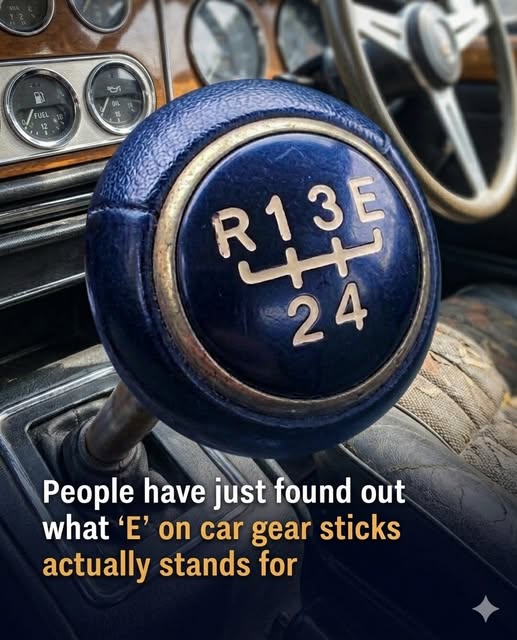
You’re kidding me😯
The interior of a modern automobile is a masterclass in digital minimalism, a sanctuary of touchscreens, haptic feedback, and hushing acoustic glass. For a driver born into the era of seamless automation, the center console is often a clean slate, featuring perhaps a rotary dial or a discreet toggle to select a direction of travel. Yet, for those who spent their formative miles behind the wheel of vehicles from the late twentieth century, the gear shifter was a tactile map of mechanical intent. It was a physical interface where every letter and number represented a distinct state of the machine. Amidst the ubiquitous “P” for Park and “D” for Drive, there was once a frequent, if now mysterious, inhabitant of the shifting gate: the letter “E.” To the uninitiated in 2026, this character might seem like a relic of a forgotten language, but its history tells the story of an industry’s first earnest attempts to balance the thrill of the open road with the cold reality of resource management.
In the analog golden age of the 1980s and early 1990s, the “E” stood for “Economy.” It was a dedicated mode born out of a world still reeling from the memory of fuel crises and the sudden, sharp rise in the cost of a gallon of gasoline. During this period, the relationship between the driver and the engine was far more transparent and manual than it is today. To engage “E” was to enter into a silent pact with the vehicle’s transmission. Once selected, the car’s internal logic—then governed by early electronic control units or sophisticated hydraulic valves—would fundamentally alter the vehicle’s behavior. The shift points were recalibrated to occur much earlier in the RPM range, coaxing the transmission to reach its highest, most efficient gear as quickly as possible. This reduced engine speed, lowered the mechanical roar to a steady hum, and, most importantly, sipped rather than gulped fuel.
Driving in Economy mode was an exercise in patience and smooth transitions. It discouraged the aggressive “kick-down” shifts that drivers used for rapid overtaking, instead favoring a gradual buildup of momentum. In some more advanced models of the era, engaging the “E” also dampened the sensitivity of the throttle. A heavy foot on the gas pedal would no longer result in a sudden surge of power; instead, the car would respond with a measured, deliberate acceleration, effectively acting as a mechanical conscience for the driver. It was a feature that allowed the person behind the wheel to exert direct influence over their environmental footprint and their wallet, a hands-on approach to efficiency that preceded the “set it and forget it” philosophy of the twenty-first century.
As we move through the mid-2020s, the physical “E” on the gear lever has all but vanished, a victim of its own success and the relentless march of technological optimization. The disappearance of this dedicated gear position was not an abandonment of economy, but rather its total integration into the DNA of the modern car. Today’s engines are governed by sophisticated onboard computers that process thousands of data points every second—altitude, ambient temperature, fuel quality, and even the driver’s biometric stress levels. With high-precision fuel injection and continuously variable transmissions (CVTs) or multi-speed gearboxes with ten or more ratios, the car no longer needs a human to tell it to be efficient. It is perpetually seeking the most economical path forward, making the manual selection of an “Economy” gear as redundant as a hand-cranked starter.
The transition from a physical lever to a digital algorithm reflects a broader shift in our relationship with technology. Where once we had to slide a piece of steel into a specific notch to save fuel, we now simply press a haptic button on a dashboard or, more frequently, allow the car’s “Eco” software to run silently in the background. The evolution of aerodynamics and the advent of low-rolling-resistance tires have further marginalized the need for a dedicated economy gear. The modern vehicle is a holistic system designed for efficiency from the drafting board to the showroom floor, leaving the “E” of the past to exist primarily in the memories of those who remember the satisfying “clunk” of the shifter finding that specific, frugal groove.
However, the letter “E” is currently experiencing a profound and ironic rebirth in the automotive lexicon. In the burgeoning era of the Electric Vehicle (EV), the letter has returned to the center console, but its meaning has been radically transformed. No longer representing “Economy” in the traditional internal combustion sense, it now signifies “Electric” propulsion or “e-Pedal” modes. In these modern machines, selecting “E” might engage regenerative braking systems so powerful that the driver rarely needs to touch the traditional brake pedal, or it might simply serve as a reminder of the silent, lithium-ion heart beating beneath the chassis. The letter has traveled a full circle: starting as a mechanical workaround for fuel consumption and arriving as the primary symbol of an era that has moved beyond liquid fuel entirely.
The story of the “E” on older gear sticks is a bridge between two very different philosophies of travel. It connects the generation of drivers who understood their cars through mechanical resistance and audible cues to a new generation that views the car as a sophisticated mobile device. It reminds us that there was a time when saving fuel was an active choice, a physical movement of the hand that reflected a conscious decision to be more mindful of the world outside the windshield. To look back at an old Mercedes-Benz or a classic Volvo and see that lonely “E” nestled between the Drive and Low positions is to see a waypoint in history.
Ultimately, the vanishing “E” symbolizes the invisible nature of modern progress. As our machines become more intelligent, they require less of our direct intervention. We have traded the tactile satisfaction of the gear shifter for the quiet efficiency of the algorithm. Yet, something of the spirit of that old Economy mode remains. It lives on in every hybrid that silently glides through a school zone and every electric car that recaptures kinetic energy on a downhill slope. The “E” may no longer be a physical notch on a stick, but the intent it represented—the desire to go further with less—remains the driving force behind every innovation that rolls off the assembly line in 2026. It is a testament to the fact that while the symbols on our consoles may change, our journey toward a more efficient future remains a constant, unfolding narrative.






Post Comment