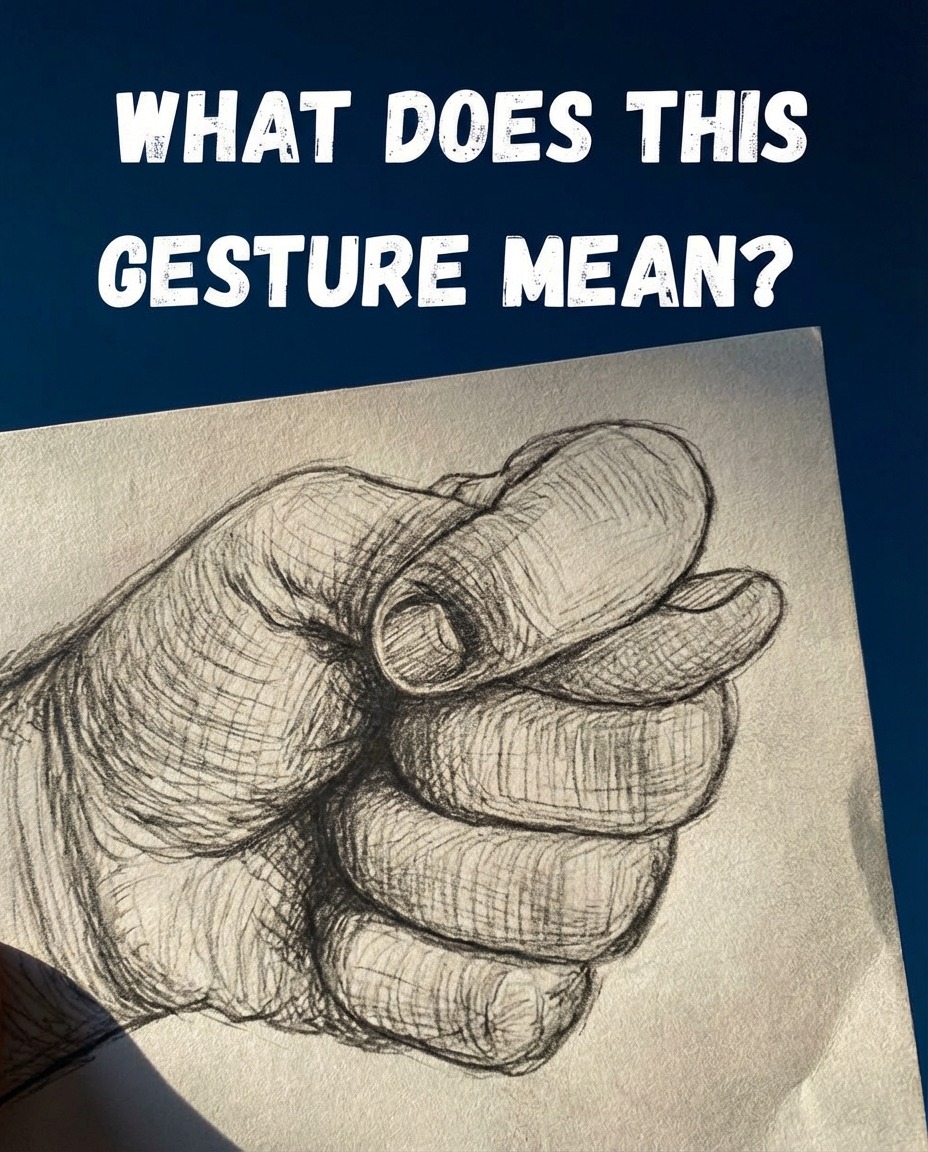
What does this sign that everyone makes mean – It hides a deep meaning 😮 I’ll tell you everything in the comments
At first glance, it resembles a simple clenched fist. But look closer: the thumb is tucked tightly between the index and middle fingers, protruding slightly like the stem of a fruit. This small adjustment transforms the hand into the “fig sign” (known as *mano fico* in Italian or *figa* in Portuguese), one of history’s most enduring nonverbal gestures. Long before emojis or text abbreviations, this quiet motion conveyed refusal, defiance, or a firm “no”—all without uttering a word.
The gesture traces back to ancient Rome, where it was called *manus fica* (“fig hand”). During the Lemuria festival—a ritual to appease restless ancestral spirits—the *paterfamilias* (head of the household) would make the sign to ward off evil spirits of the dead. Its shape evoked the fig fruit, a symbol of fertility and life force, believed to repel the evil eye, jealousy, or misfortune. In Mediterranean and Southern European cultures, including Italy, Turkey, and Slavic regions, it functioned as an apotropaic charm—protective against bad luck or curses. Amulets shaped like the *mano fico* (often in coral, silver, or jet) were worn or carried as talismans, blending superstition with everyday life.
Over centuries, the sign evolved in meaning while retaining its core subtlety. In 19th-century European villages, it became a discreet way to resist authority or unfair demands without escalating conflict—offering pushback laced with humor or irony. Elders might use it playfully against teasing children, or family members could flash it during tense moments to signal quiet resolve. In some contexts, it carried deeper emotional weight: a gesture of comfort during uncertainty, separations, or challenges, embodying hidden strength (the closed fist) guarded by vulnerability (the tucked thumb). Yet its origins also include mildly obscene connotations—symbolizing sexual union or female genitalia—which made it insulting in places like Turkey or Russia, akin to giving the finger.
Today, the fig gesture has largely faded from common use, replaced by digital reactions, thumbs-down emojis, or direct texts. In many Western societies, younger generations may not recognize it at all. Yet in Brazil and Portugal, *figa* charms remain popular for good luck and protection, often seen as jewelry or home decorations. Its decline reflects how much of our unspoken language has migrated online, but the essence endures: powerful messages can thrive in subtlety, wit, and restraint.
The fig sign reminds us that communication once relied on shared cultural knowledge—small, wordless acts that conveyed volumes. In an era of explicit expression, its quiet defiance and protective spirit feel almost nostalgic, proving that some symbols speak louder without saying a thing.






Post Comment