I helped a lost grandmother during my night shift. The next morning, her daughter handed me a shoebox and said, “This is going to change your life.” – Story
I’d answered hundreds of “suspicious person” calls in my career, and at 3 a.m. they all blurred together — shadows under streetlights, half-asleep complaints, nothing that usually lingered past sunrise. But that night unraveled something I didn’t even know was waiting to be found.
I was adopted as a toddler after several years in foster care. My adoptive parents gave me stability, patience, and a last name I’ve worn with pride for decades. I built a life on that foundation — badge, partner, mortgage, routine. Still, there were gaps in my history I learned to live around. Sealed records. Sparse paperwork. A birth story reduced to a paragraph. I told myself it was enough.
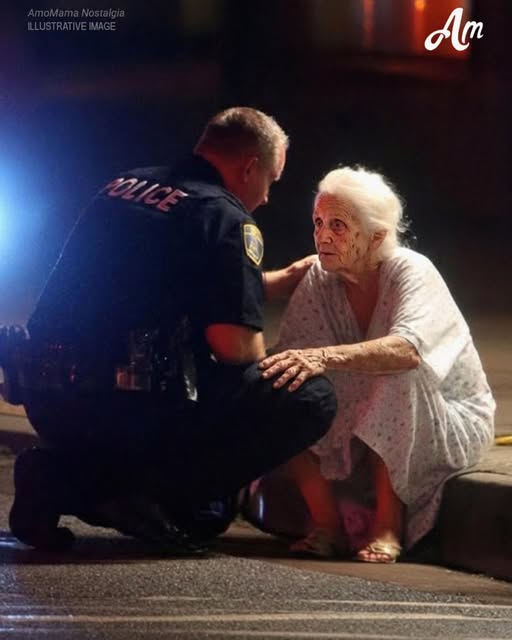
The call came from a quiet neighborhood: an elderly woman wandering barefoot near an intersection. When I arrived, she stood under a streetlamp in a thin nightgown, trembling, confused. She wasn’t dangerous. She was lost.
Her name was Evelyn.
I knelt beside her instead of reaching for cuffs. She kept apologizing, saying she needed to get home, that her husband would worry. He’d been dead ten years, according to the ID in her purse. Between fragments of memory, she whispered about a baby boy she “couldn’t keep safe.” Her voice broke when she said his name.
“Cal,” she murmured. “My little Cal.”
I stayed with her until paramedics arrived. She clutched my hand like I was an anchor. Even after she was safely transported, that name stayed with me.
Cal.
My name is Caleb.
Later that morning, a woman in her forties knocked on my door. She introduced herself as Tara — Evelyn’s daughter. The state had accidentally mailed her a box of old documents related to her mother’s medical history. Inside, she said, were hospital records from 1988 referencing a baby boy named Caleb born to Evelyn.
1988 was my birth year.
I felt the air leave my lungs.
It had to be coincidence. Caleb wasn’t exactly rare. I told myself that. Still, the timing, the name she’d whispered before knowing mine — it gnawed at me.
I called my adoptive parents. They were stunned but steady, reminding me they’d been told my records were sealed and complete. “Whatever you find,” my mother said gently, “you’re ours. That doesn’t change.”
Tara and I ordered DNA tests. The waiting was worse than any stakeout I’d ever done. Old fragments of memory surfaced — a humming lullaby, the feeling of being held, a woman crying. I’d always assumed they were inventions of a child who wanted a beginning.
The results came back two weeks later.
Tara was my biological sister.
Evelyn was my mother.
When I visited her care facility, Tara walked me into her room. Evelyn looked smaller than I remembered. For a moment, her eyes were distant. Then they focused on my face. Her hand rose slowly to her mouth.
“Cal?” she whispered.
I nodded.
She began to cry — not loudly, but with a kind of release that seemed decades old. Her memory would fade again within minutes, the doctors warned. Dementia doesn’t bargain. But in that brief window, something settled between us. The guilt she’d carried, the question I’d lived with — both softened.
I didn’t lose one family and gain another. I gained context. My adoptive parents are still the ones who raised me, who taught me right from wrong, who pinned on my first badge. But now I know where my eyes come from. I know the voice behind that half-remembered lullaby.
I’m back on night patrol, answering the same calls. Only now, when dispatch reports a “suspicious person,” I pause a little longer before assuming anything.
Sometimes people aren’t suspicious.
Sometimes they’re just lost.
And sometimes, when you answer the call, you find the missing piece of yourself waiting under a streetlamp at 3 a.m.



Post Comment