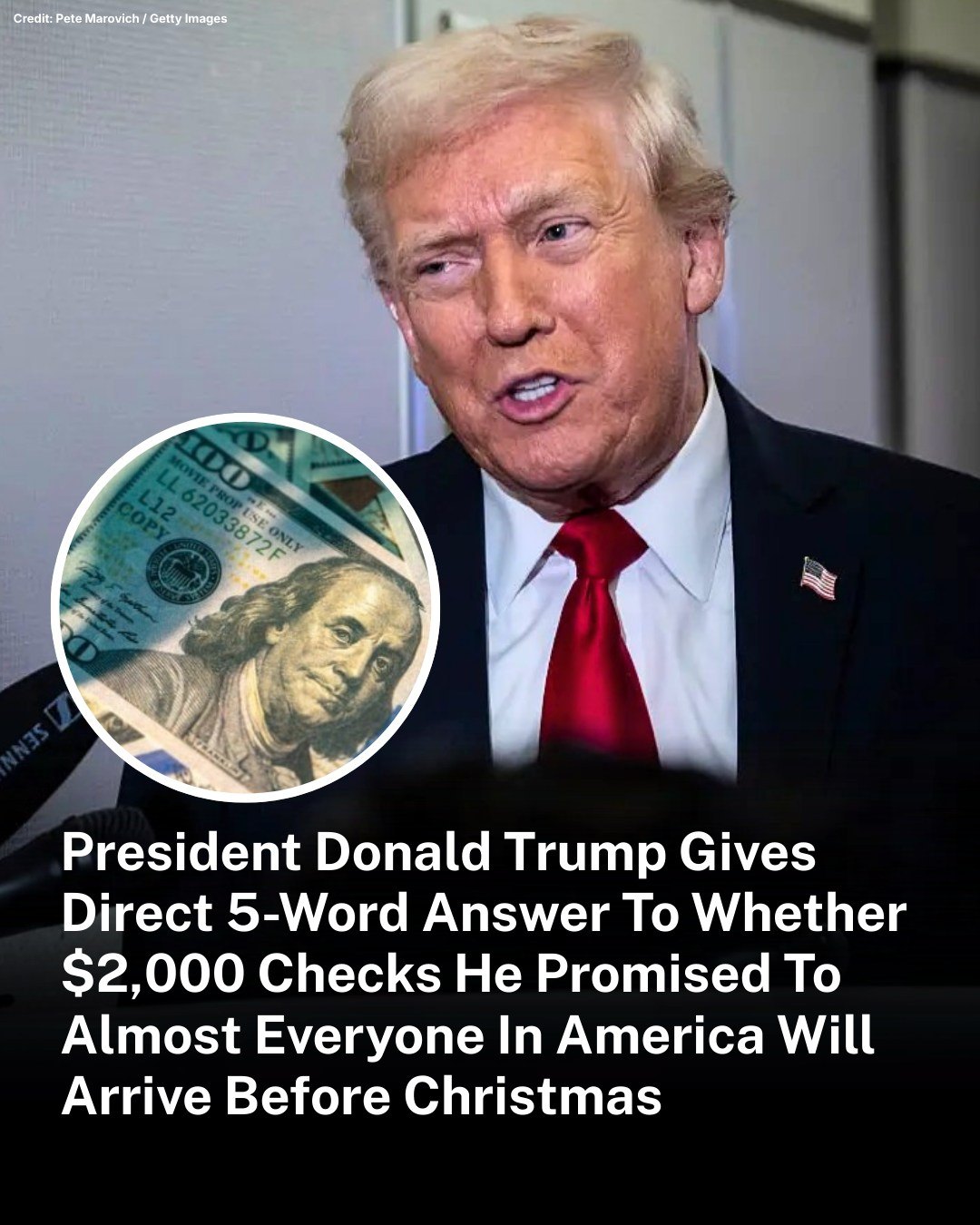
The President has given a definitive response 👀
President Donald Trump has reignited debate over economic relief by proposing a “tariff dividend” — a one-time $2,000 payment to what he calls “moderate-income earners.” The concept would direct part of federal tariff revenue back to households. However, Trump has made clear that no payments will arrive before 2026, likely aligning with the midterm election cycle.
Trump has argued that the U.S. has collected “hundreds of millions of dollars in tariff money,” suggesting it could be split between reducing national debt and eventually issuing dividends. Unlike traditional stimulus checks funded through federal spending, these payments would rely specifically on revenue generated from imported goods.
Economists, however, have questioned whether the math adds up. Erica York of the Tax Foundation noted that if all adults earning under $100,000 qualified, the cost could reach nearly $300 billion. Yet total tariff collections as of September 2025 were only about $195 billion, leaving a substantial gap between available funds and the proposal’s potential price tag.
Some officials have suggested financing the payments based on projected future tariff revenue, citing estimates of roughly $3 trillion over the next decade. But analysts warn that such forecasts depend on uncertain geopolitical and trade conditions.
Trump has emphasized that only middle- and lower-income households would qualify, excluding high earners. While no official income thresholds exist yet, economists commonly classify lower-income households as under about $55,820 and middle-income households between $55,820 and $167,460. Past stimulus programs phased out at similar ranges, hinting at what could apply here.
Despite rising public interest, no congressional approval or Treasury framework currently exists for a tariff dividend. Trump reiterated recently, “It’ll be next year sometime,” signaling that implementation remains distant.
The proposal also raises broader questions about policy and public trust. Can tariff revenue sustainably fund direct payments without increasing consumer costs or provoking new trade disputes?
For now, the tariff dividend remains an early-stage idea — ambitious, politically appealing, but far from becoming reality.






Post Comment