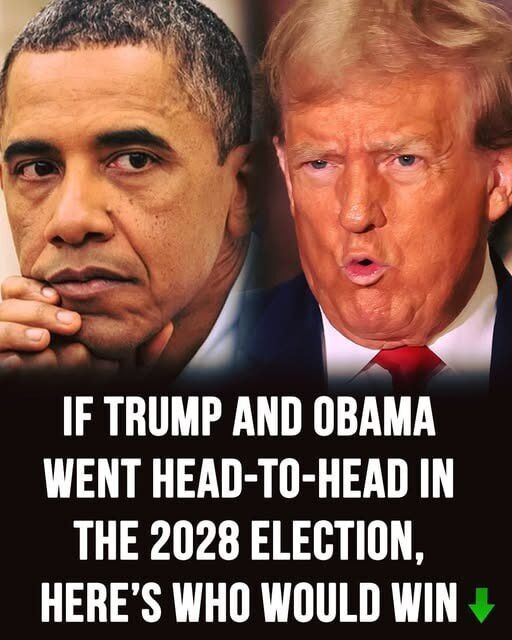
The result isn’t what people would expect Full story in comments
It sounds like political fiction: Barack Obama and Donald Trump facing each other in a future presidential election. Two of the most influential and polarizing figures of modern America, standing on the same debate stage. Constitutionally, this can’t happen — the 22nd Amendment clearly limits presidents to two terms. Obama completed his second term in 2017, and although Trump returned to power in 2024 after a dramatic political comeback, he also cannot legally run again. Still, the “what if” refuses to fade.
A recent Daily Mail/J.L. Partners poll asked 1,013 voters who they would support in a hypothetical 2028 race between the two men. The results were decisive: **52% chose Obama, 41% chose Trump, and 7% remained undecided**. Obama performed especially well among minority voters — 73% of Hispanics and 68% of Black voters — and maintained a strong lead among independents. Notably, he was the only Democrat in the survey who clearly defeated Trump, outperforming Biden, Clinton, and Harris.
The fascination with this impossible matchup speaks to the lasting power of their legacies. Obama’s presidency reshaped the Democratic coalition with themes of hope and unity, while Trump’s rise was largely a reaction to those years, built on populist nationalism and political disruption. Even after leaving office, both men command intense loyalty and attention. Obama represents stability and integrity for many Americans, while Trump symbolizes resistance to the political establishment for his supporters.
Speculation about Trump seeking a third term has circulated online, encouraged by his own playful remarks. But legally, the path is nonexistent. Changing the 22nd Amendment would require overwhelming political consensus that simply doesn’t exist.
Ultimately, the Obama–Trump matchup remains fantasy — but a meaningful one. It reveals how deeply these two figures continue to shape American identity. Though neither will appear on a future ballot together, their influence still defines the country’s political imagination.




Post Comment