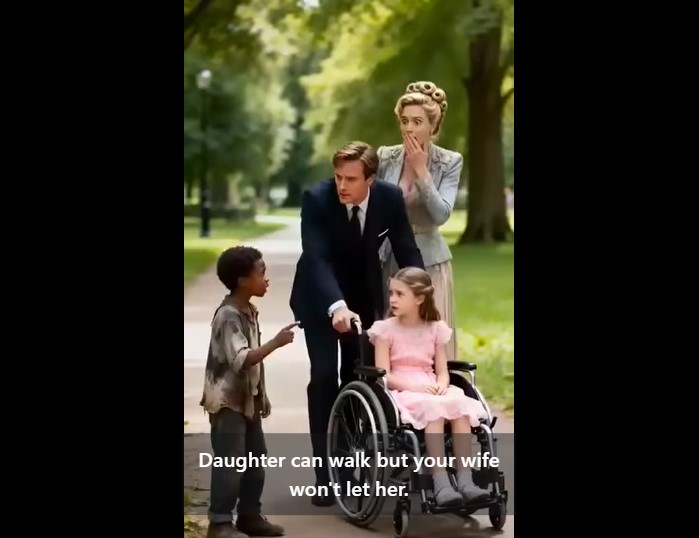
“She could walk… but your WIFE is stopping her.” The words didn’t come from a doctor. They came from a POOR STRANGE boy. – StoryV
The first time Fernando Harrington heard the sentence, it came from a boy’s mouth like a crack in glass.
“She can walk,” the kid said. “Your daughter. But your fiancée won’t let her.”
Fernando almost laughed it off. His daughter Elena had been in a wheelchair for months. Doctors, routines, supplements—Viven Clark handled everything with practiced calm. Fernando trusted her because grief had made trust easier than looking too closely.
But the boy’s eyes held something adults rarely noticed in children: certainty.
Inside the mansion, Fernando found Elena where she always sat, facing the windows, hands clenched tight. Beside her stood Viven, elegant as ever, holding a glass of orange juice.
“Elena needs her routine,” Viven said smoothly.
Elena’s eyes flicked to the glass. Then to Viven. Then down.
Fernando felt something twist in his gut.
“What’s in that?” he asked.
Viven smiled. “Her supplement. You know that.”
Before Fernando could reply, a voice cut in from the doorway.
“That drink isn’t medicine,” said Immani Reed, one of the house staff. “It’s a leash.”
The room froze.
“She can move,” Immani continued, pointing at Elena. “I’ve seen it. And every time she tries, that drink comes back.”
Viven dismissed her with a soft laugh, but Fernando was watching Elena now—really watching. The flinch. The fear. The way she checked Viven’s face before breathing.
“Elena,” he whispered. “What did she give you?”
Elena hesitated, eyes darting to Viven. That reflex was answer enough.
“Orange,” she whispered. “She said I had to finish it.”
Fernando stepped between his daughter and Viven without realizing he’d moved. Something ancient had woken in him too late but loud enough now.
“Try,” Immani said gently to Elena. “Just your toe.”
Fernando held his breath.
For a moment, nothing happened.
Then Elena’s toe twitched.
Once. Twice.
Small. Shaky. Undeniable.
Elena sobbed like she’d broken a spell.
Viven rushed forward. “Stop this. You’re hurting her.”
Fernando raised his hand. “Don’t.”
His voice shook, but it held.
He searched the house like a man clawing through lies and found it in the freezer: a jar of white powder wrapped carefully in plastic. Evidence hidden in plain cold.
When the police arrived, the mansion stopped being a home and became what it always had been.
A crime scene.
Tests confirmed it weeks later. Elena’s condition wasn’t mysterious. It was chemical. Slow. Intentional.
Fernando didn’t defend himself with excuses. He sat beside Elena through therapy, every painful inch of progress. Immani stayed, not as staff, but as family.
And the boy—the one who spoke first—Fernando thanked him on his knees, because listening late was better than never.
Months later, under fluorescent lights, Elena took her first step between parallel bars. No music. No miracle.
Just effort.
Just truth.
Fernando cried without shame.
“I thought I was broken,” Elena whispered.
“You weren’t,” he said. “You were trapped.”
Real love, Fernando learned, doesn’t control or silence. It protects. It listens. It checks the truth—especially when someone else can’t fight for themselves.
Elena wasn’t fragile.
She was free.






Post Comment